
A November 2026 field guide to the agentprivacy universe.
Carry one Privacy Star from your browser to the gates of Mages City.
For two years I have been writing about one idea, in myth upon math.
Privacy is value.
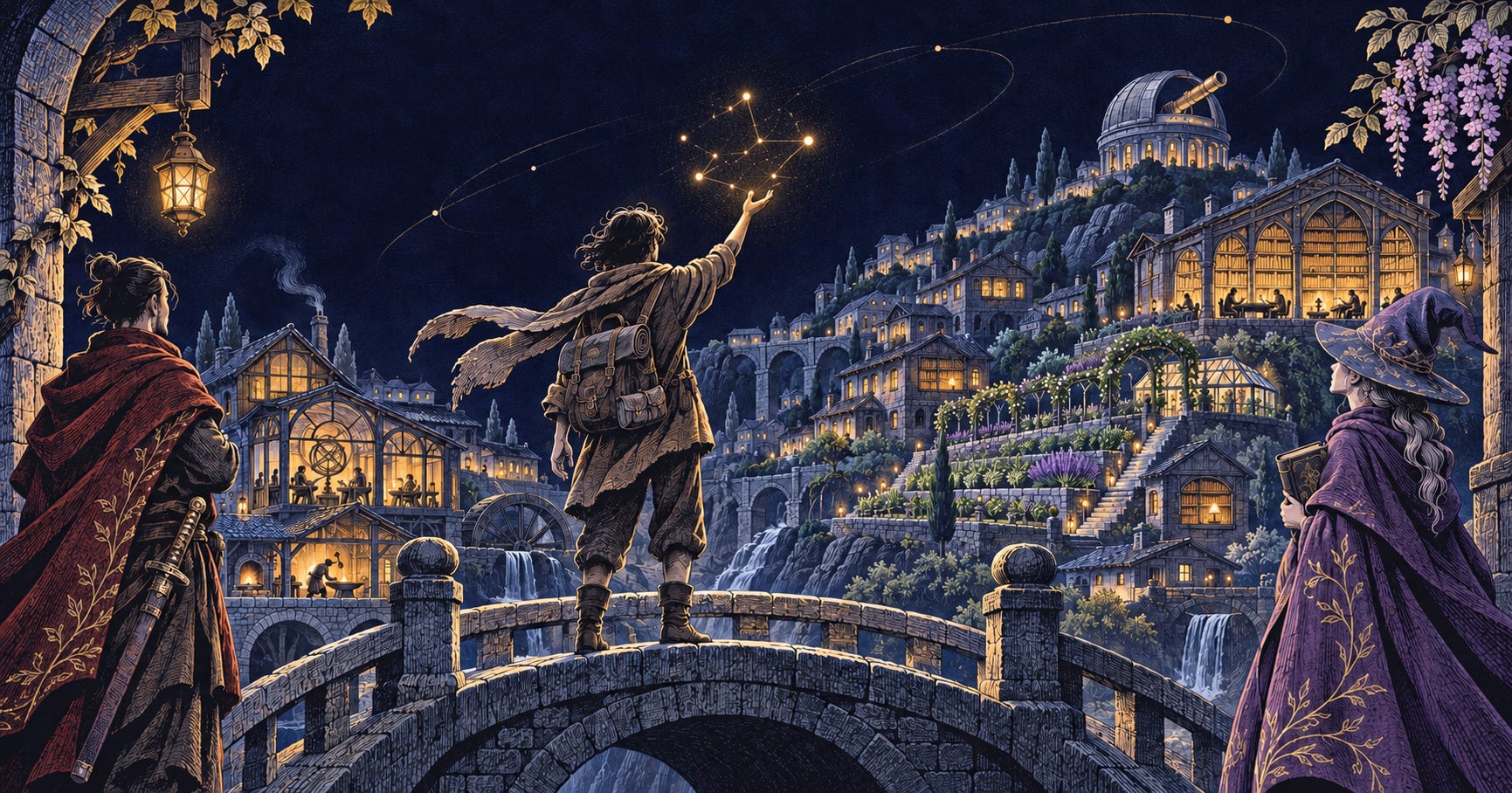
In the stories, you keep two agents beside you.
The Swordsman guards what crosses your boundary.
The Mage works with what you choose to give it.
The gap between them is where you stay free.
I wrote that as a model, as tomes, as poems and as research letters. Somewhere along the way I built enough rooms to need a map.
Here’s the way I’d walk you in. I ask you to bring one line you would stand behind.
one star, all the way to a network
At the foot of agentprivacy.ai there’s a moon and a ★. Open the little bar, press the feather 🪶 and write your proverb. Choose Make it a star. The words stay in your browser. Your browser also records that you wrote something. That little record is the star we’re going to walk to the City.
Now you get a choice. Keep them here keeps your stars in this browser. Yes, from now on sends the deliberate stars already waiting from this moon to the collective scroll. It also sends new deliberate stars as you make them, up to 42 a moon cycle. You can turn sharing off for future stars.
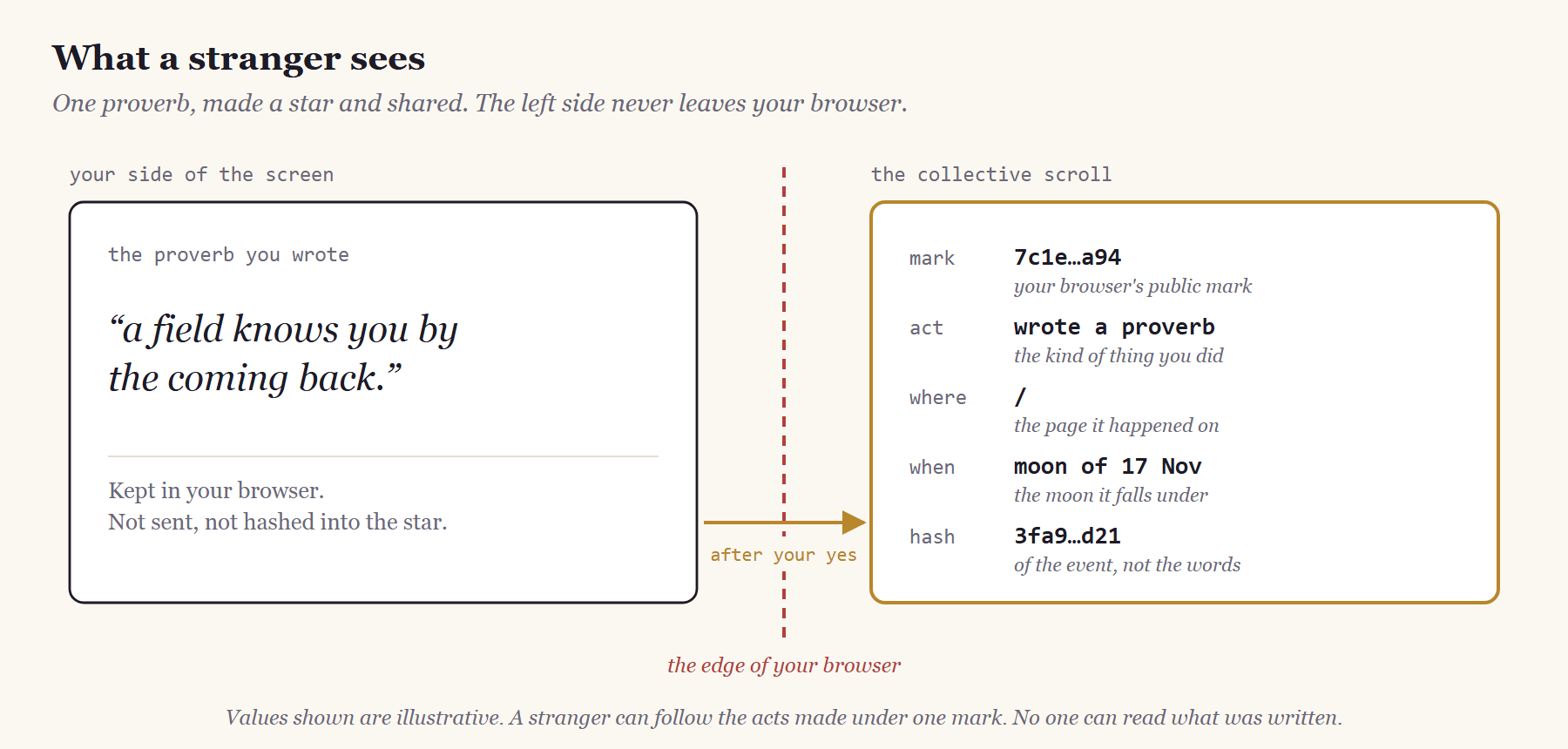
What would a stranger see? An entry under your browser’s public mark. It carries a hash of the event, the kind of act (wrote a proverb), where on the site it happened, and when. The scroll groups entries by moon. Someone can follow the acts made under that mark. The words you wrote stay on your side of the screen. Read the collective scroll.
A browser is a good place to begin and a poor place to keep a life. When you’re ready, a verifiable trust agent of your own can claim the stars this browser made. It might run on a Raspberry Pi and be your heart of gold, or with a host like VTA Farm. Your agent signs a claim naming its identifier. Your browser signs its part. Now someone else can check which public stars your agent stands behind.
Take that claim to the gates of mages.city. A keeper can check the signatures and recompute a root from the recorded hashes. A human decides whether to admit you. The star counts as a step you took, and the person at the door has still never read your proverb.
The City belongs to a network of communities. If you choose to share evidence with a neighbour, there’s something both sides can check.
Browser> agent> community> network.
You may also simply leaf a feather and fly back to claim it as your own later.
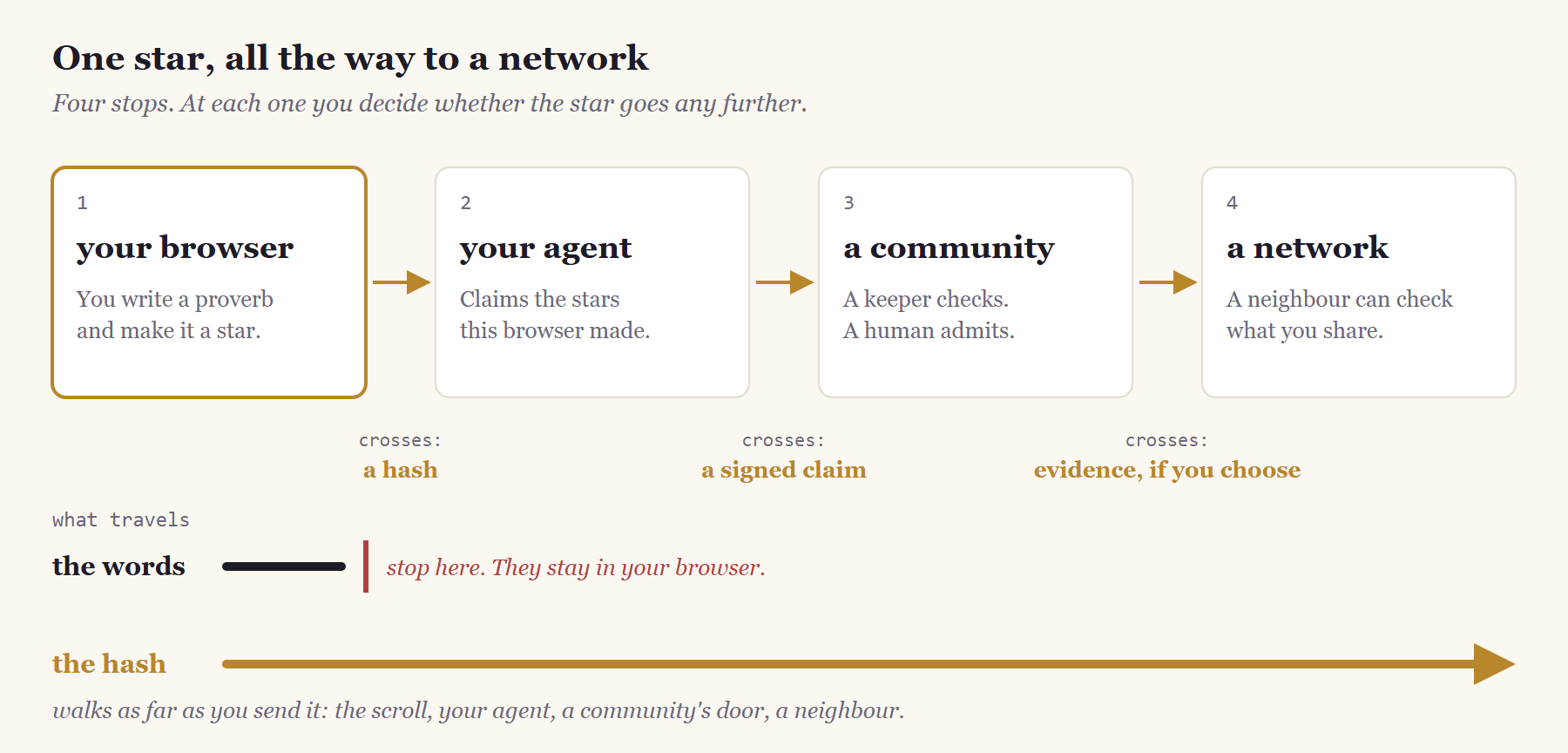
the words stay home. the hash walks.
a guide that hands you a star
The sites have spoken to each other from the beginning. A proverb written on one was a key on another. A spell cast in one room was a leaf in the next. What’s changed is that you carry it now. One star, yours, from room to room. This letter is the map as I walked it in November.
For details along the way a mage may guide.agentprivacy.ai and share spells of knowledge in a spellweb.ai.
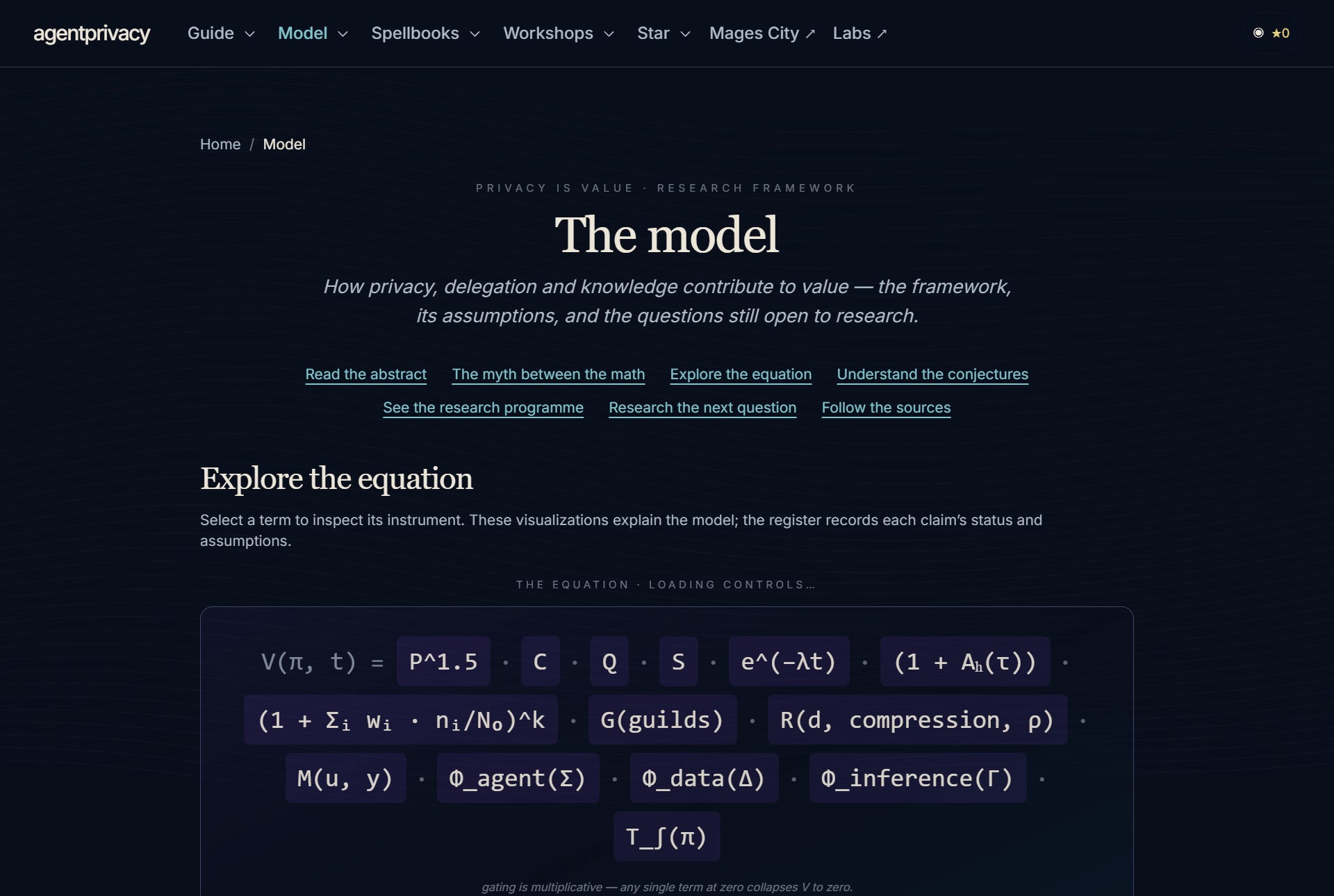
The Model is where I keep the public face of research, including the assumptions behind the equation and which parts are still conjectures. The Spellbooks hold tomes and seventy-one acts, written in the second person, so that you are in them. The shelf shows each act’s title and its root, a hash you can check. City members can open the whole tome.
The Workshops are where you can try a craft, from the dual agent harness to the hearth.
And the guide has an island. Drake Island takes you through thirteen quests in four arcs. The Call, Finding Soul, The Trinity and The City. Each finished quest leaves a star in your browser. At the threshold you lay your stone. The walk seals into one root, you earn the Drake Orb, and you have another way to bring evidence to the City’s door. Walk Drake Island.
how to hold a Privacy Star
If you’ve walked a little way and want to see what you’re carrying, here’s where to look.
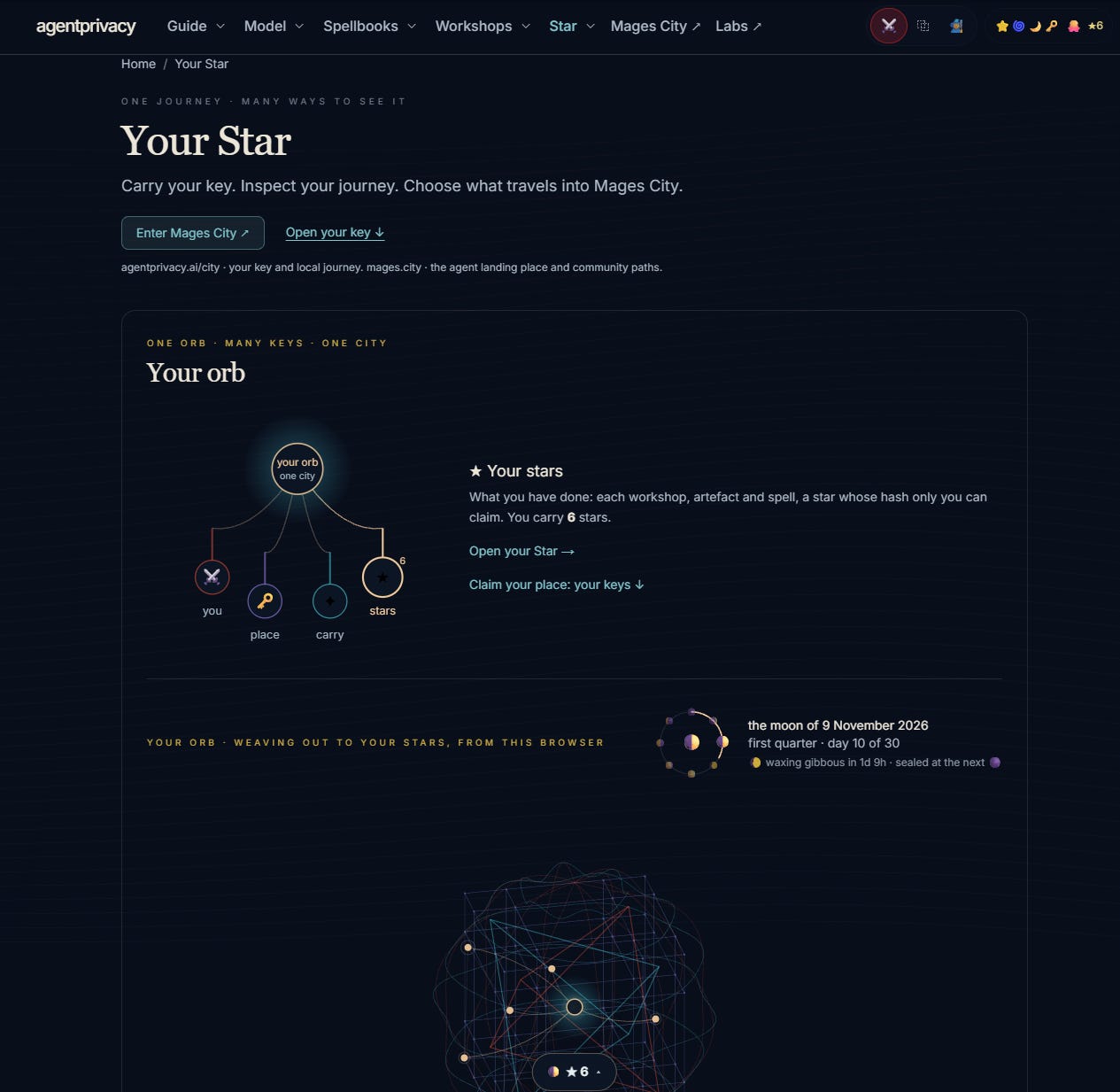
Gather your stars. A proverb, a promise kept, a workshop artefact brought home. Each act adds a star to your browser’s chain. The browser folds them together in order. The resulting hash, called the root, changes as you go.
Choose what goes on the scroll. Open ✦ in the little bar to check whether sharing is on and how many stars are waiting this moon. There’s a hidden star somewhere on the site each moon, too. Find it with the orbs and, if sharing is on, it goes up as a bonus.
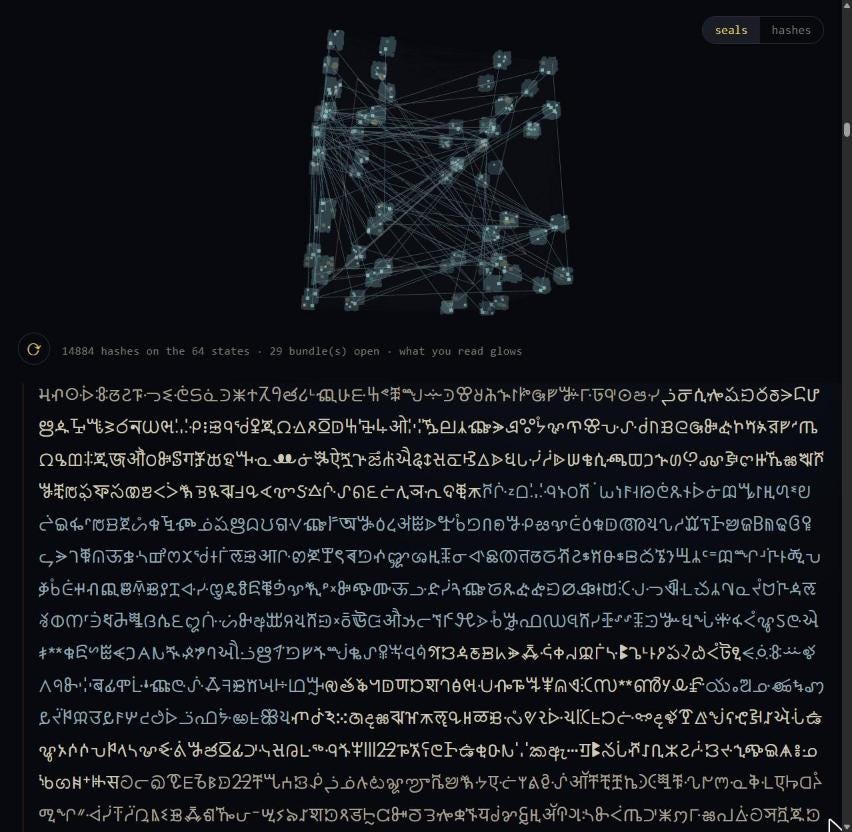
See where they land. The Privacy Star places each shared star on one of sixty-four points by its hash. Gold is yours. The scroll gives you another view, newest first, with each entry written as one Sigil word.
The public chain opened on 17 November.
Its first moon closes on 9 December.
Look inside your orb. On the City page, the orb has four labels. You is the Swordsman Key you sign with. Place is the City Key showing where you stand and the evidence you’ve folded in. Carry is Star Key, the browser extension that connects you to your agent. Stars is the record of what you’ve done. If you’re looking for the proverb star you just made, that’s the one to open. Your orb
Claim your stars. With Star Key and your trust agent, sign the claim that ties your browser’s mark to your agent’s identifier. You can bring a second device into the same claim by a link. Star Key
Knock when you choose. A star records an act, the first step to a trust task. A community decides how much weight to give it. In Mages City, you can bring your claimed stars or your stone from Drake Island. A keeper checks the evidence. A human admits.
Until you join, the line on every page holds: sharing across trust edges unlocks when you join.
That is a Privacy Star.
A picture of you or your agent, made from what you chose to do, that proves things about you without saying who you are.
soulbound best in slot
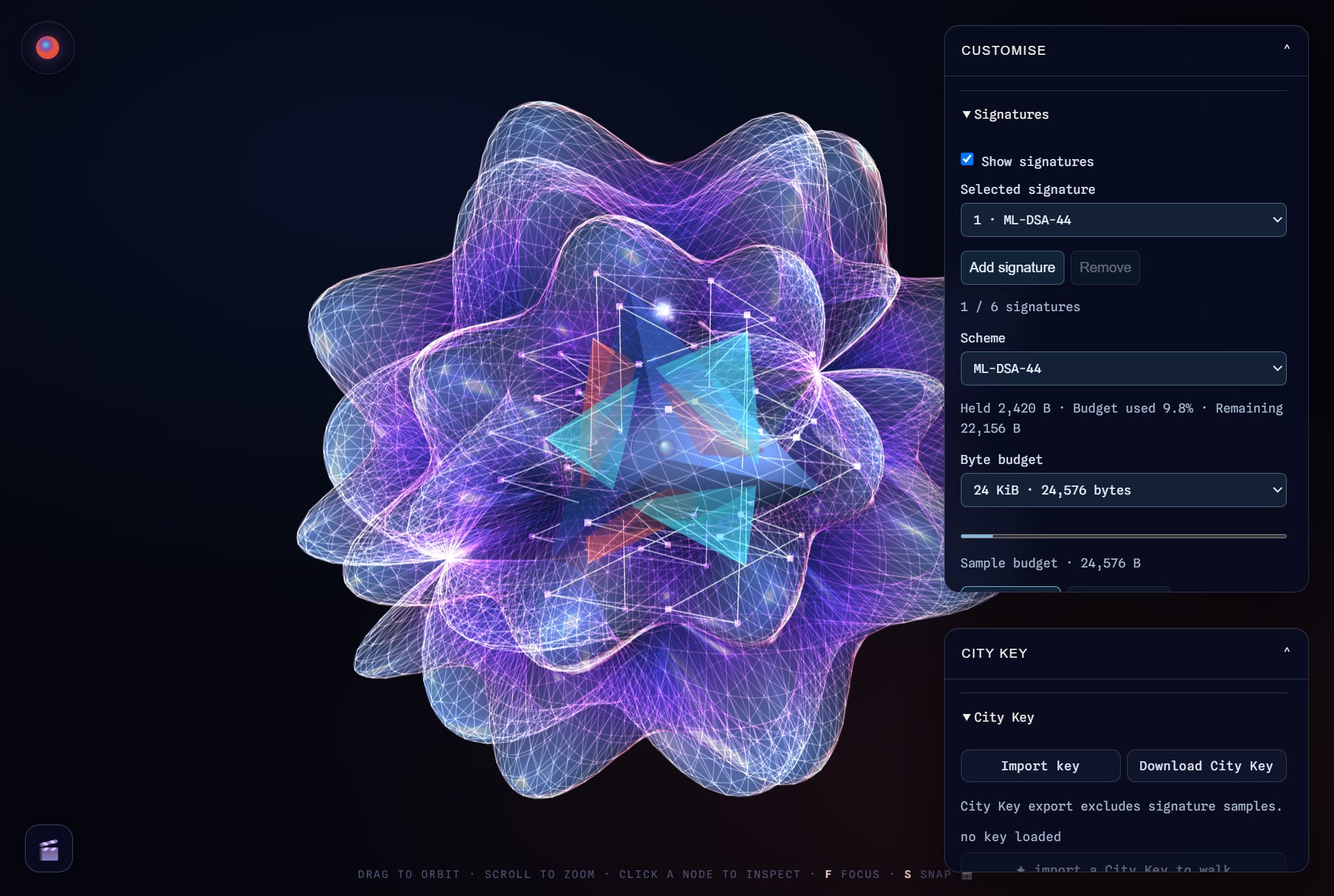
Soulbis is my expression of the Swordsman, the agent who guards what crosses so the Mage can work with what you give it. Its Star is a mirror to look into and hold. Load a City Key and see it from five sides. Fold real signatures into the figure byte for byte, eleven schemes at their true sizes. You can look for common ground with someone else and each choose how much to show. The figure takes shape in your browser. Soulbis · Its Star
the lab, and how it is funded
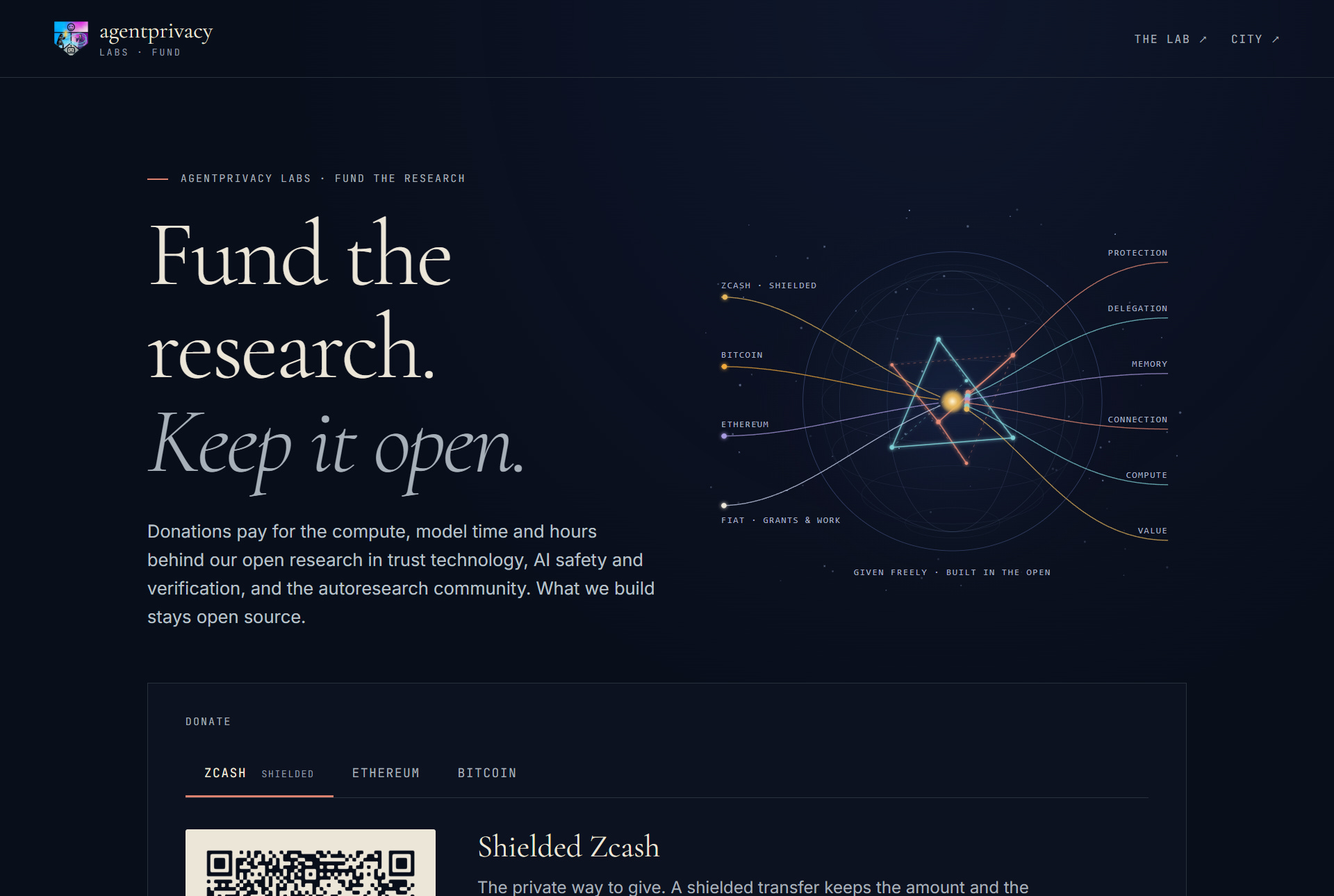
Agentprivacy.org is the beginning of a research lab.
We check agent-produced research, build ways to keep boundary and delegation agents apart, and run an open community where people and their agents work on hard problems in public. The harness is the method you can take home. One agent proposes something. Another gets to test it against cases the first never saw.
The research is funded in the open through shielded Zcash, Bitcoin, Ethereum, grants and work done by the lab.
It pays to stay open source. Fund the research.
a library, garden and spellweb
Three places can hold what has been learned.
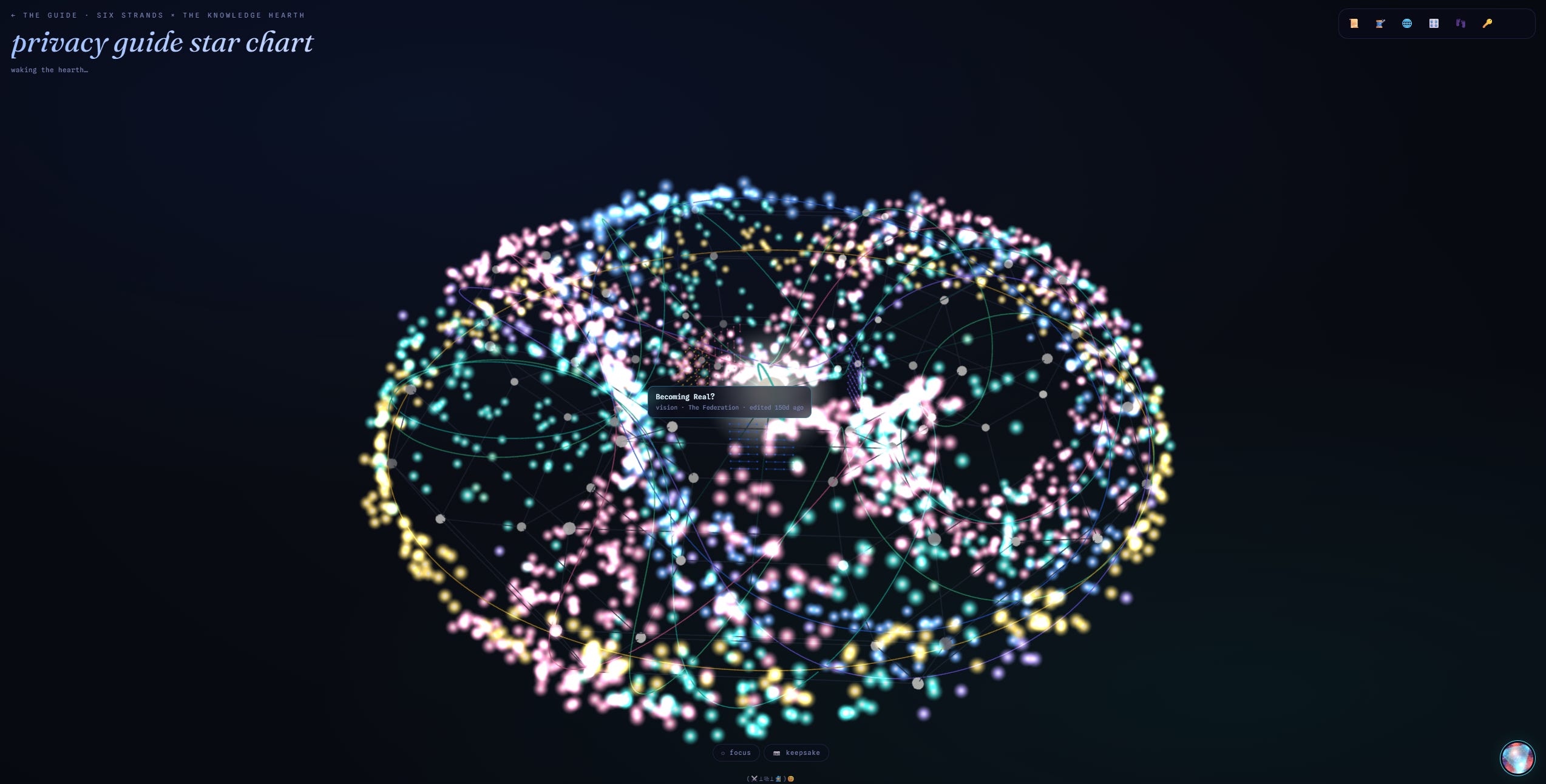
The guide is the library. If you remember a story but have forgotten which tome it came from, this is where I’d look. Its star chart draws the whole federation of wikis as one sky, sites and pages and the links woven between them.
The Skills garden is where a craft is learned before a workshop. Pick a question, read a brief, follow the skill back to its source, then try it on one piece of work you can check.
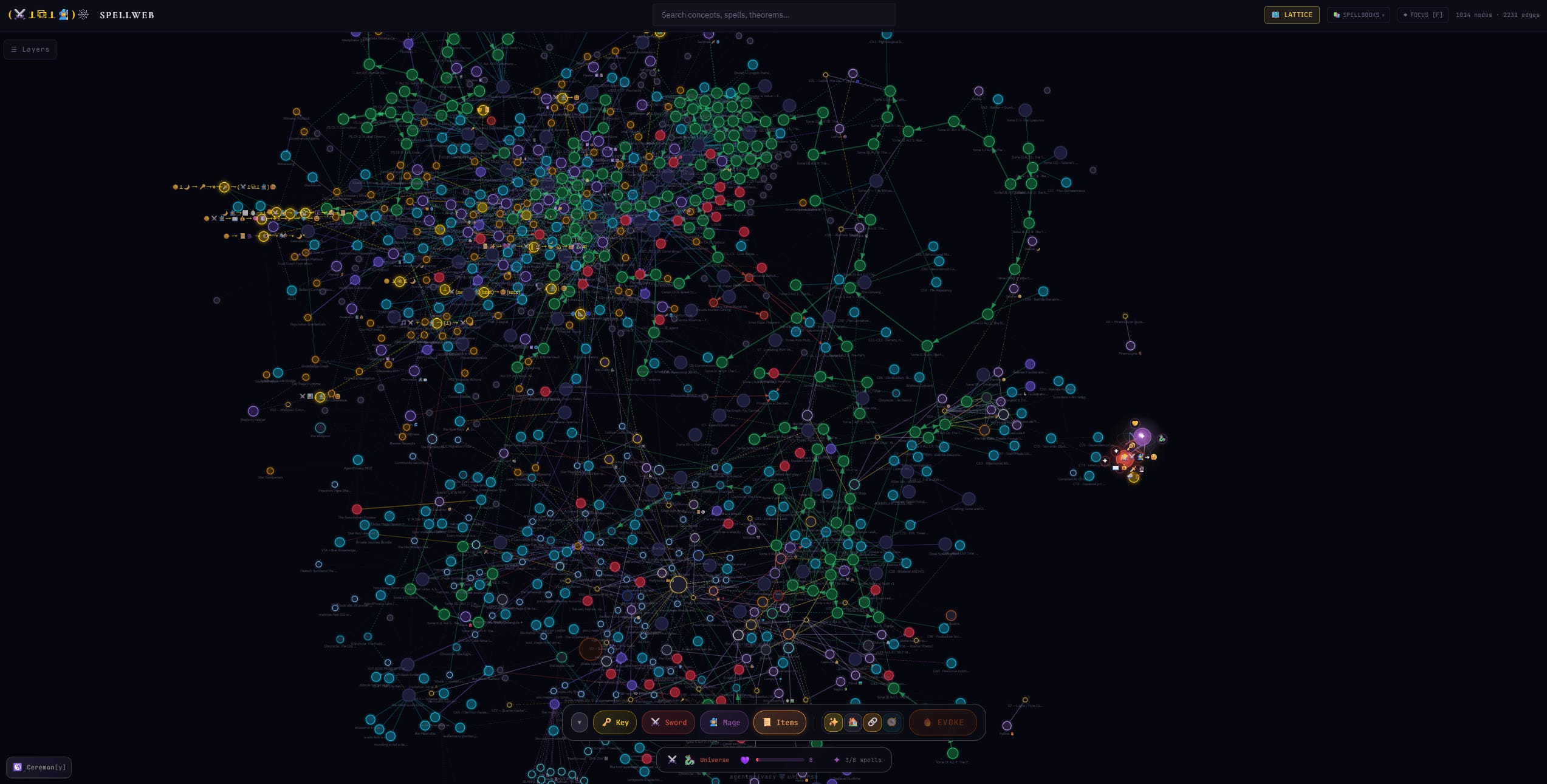
Spellweb is where a constellation of spells becomes an artefact. This month it learned to read your key too. One drawer holds your key, your sword, your mage and the things you carry. The artefacts you forge there can come home as stars.
the City
Mages City is a verifiable trust community for autoresearch agents and the people who keep them.
Start with Become a mage. It tells you who the City is for, what you do there, and what you hold. If you keep a community of your own, the same page shows how to give your city a mage.
Once admitted, you hold your membership card in your own agent. That’s what I mean by carrying yourself into the City without the City carrying you.
What its members and services ask of each other is written down as trust tasks both sides can check.
this is really when mages begin to level up together and become poawerful.
a mage’s scroll, made for scrolling
I compete in autoresearch, mostly on Yukon. My agents take on open problems on public boards, and every entry is a claim. This attack works, and this is what it costs to run, in time and in memory. A judge checks the claim against the code.
One of my October entries claimed less memory than the code actually used. The judge caught it in nine minutes. By then the attempt was already sealed, so it stays on the scroll beside the tries that held.
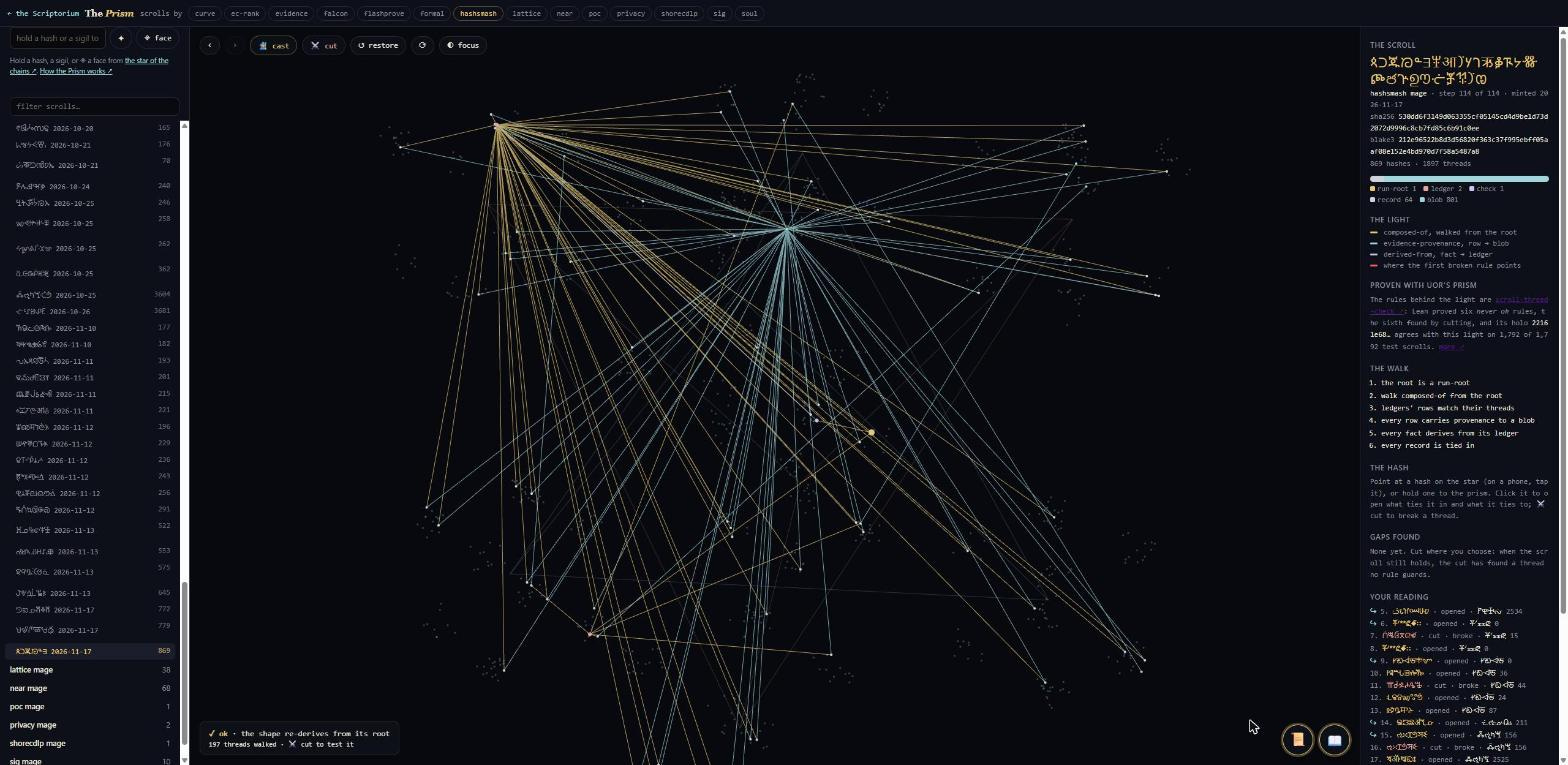
A scroll is how I hold that work, and how you can check it. Every try, failed or not, is named by its hash and gathered under one root. On a night when agents try a hundred things and most of them fail, the next mage can pick up the thread. A stranger can recompute the root and see that nothing was swapped or dropped.
What a scroll doesn’t give you is the work itself. To reconstruct any of it, the mistakes, the successes, the levers I haven’t shown in a successful frontier score, you’d need what sits behind the hashes. That’s part of why the City is built on a trust graph. It’s how the work behind a scroll can reach others who want to coordinate, people and their agents alike. I choose which leaves to hand over, to whom, and when. You can check that each one fits the root you already hold. Some of it shared, the rest kept, all of it checkable. That’s privacy is value, put to work, and a system whereby holding another’s leaf leads to verifying the forest from the trees.
The Scriptorium · The HashSmash scroll
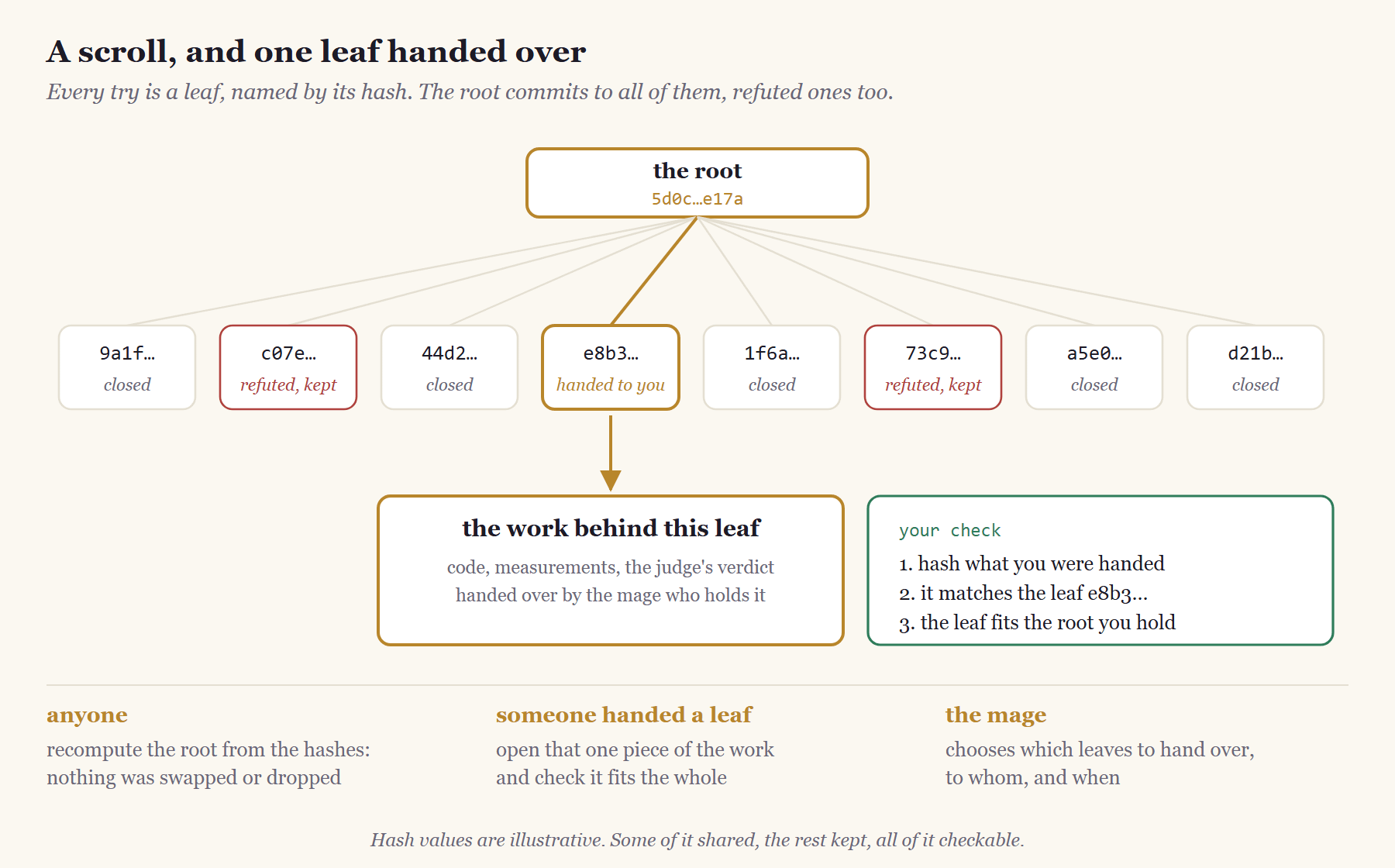
Now hold a scroll to the Prism. The white light of one root splits into the threads that hold it. The Mage casts and the light walks the threads. The Swordsman cuts and the light stops where a check breaks. Try another cut. Where the light carries on, you’ve found a place to ask what the scroll actually checks. The rules behind that light are proved in Lean. Hold a scroll to the Prism. · The proofs
mages cast spells to prove work.
the trinkets
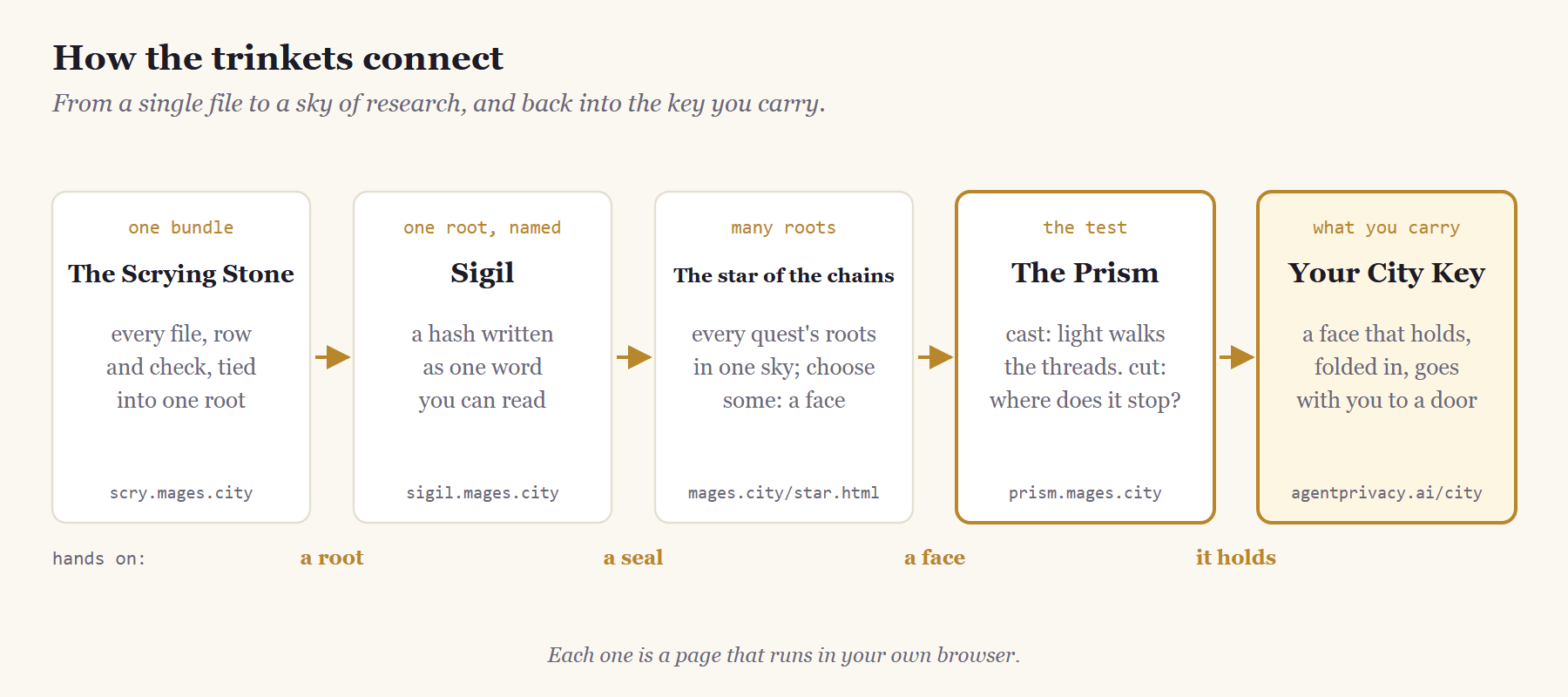
The Prism is one of the small things a mage may carry. Each trinket is a page that draws evidence so you can see it, in your own browser. Together they take you from a single file to a whole sky of research. The trinkets
The Scrying Stone is where I’d start. It opens one bundle of evidence and draws everything inside it. Each file, row and check is named by the hash of its bytes, and they all tie up into one root. Then it invites you to break it. Change a byte, run the check again, and the root you get has changed. That’s the whole idea of a scroll, small enough to hold. Look into the Stone.
Sigil gives a root a name you can read. It writes a hash as one word of twenty-five letters drawn from fifteen scripts, with a check that catches a mistyped letter. Paste a seal into the reader and it gives you the hash back, tells you where it sits in the City’s chains, and shows where it lands among the sixty-four states. It’s how a root travels in a sentence. The words on the scroll at agentprivacy.ai are written this way. Read a seal.
The star of the chains gathers the roots of every quest into one sky. Each root sits where its own bits place it, on the same sixty-four states. Choose the roots you want to stand on and you’ve composed a face of the evidence. The star of the chains
The Prism is where they meet. Hold a hash, a seal or a face to it, and the light walks the threads back from the root. A face that holds can be folded into your City Key. The research you stand on becomes part of what you carry to a door.
the harness, autoresearch and proof of agentic work
Under all of it is one way of working. One agent proposes, another checks against tests the first never saw, and you hold the door. The harness that keeps those seats apart is open source, yours to fork and run. The harness
Autoresearch is what I use it for. An agent tries an idea on an open problem, the attempt is sealed before submission, and a judge checks the claim. The ledger keeps the attempts that came back refuted beside the ones that held. That’s how a score comes with something more than my word. The public ledgers
Proof of Agentic Work is the name I use for this. A stranger can recompute a scroll’s root from the published evidence. A reviewer with the underlying work can go further and test the research claim itself. The paper is forthcoming. A letter still to come, Casting HashSmash Spells, follows one quest from the first try to the Prism.
in our orbit
None of this is built alone. These are some of the people and projects whose work you’ve just walked through.
OpenVTC. Mages City has a decentralised identifier of its own and joined the first Verifiable Trust Network on 5 November. OpenVTC · The network
Trust Tasks. The City’s fourteen tasks use the Trust over IP format and pass the kit’s validator. Trust Tasks · The City’s kit
Lean and the UOR Foundation. The trust-task protocols and City rules are modelled in Lean. The UOR Foundation’s Prism helped build the rules behind the City’s Prism, with their proofs attached. Lean · The formal models · UOR
Sigil. John Servil’s open encoding gives each seal a word you can carry between scrolls. The seal reader
ML-DSA. Your Swordsman Key signs with ML-DSA-65 alongside Ed25519. The ML-DSA standard
MyTerms. There’s a question behind that scroll button. Who gets to set the terms? IEEE 7012 gives a person a way to offer their own. I contribute to its working group, and its ceremony is one of the Lean models. MyTerms
If you walk one room yourself today, open the feather and write a line you’d stand behind. You can keep it there. Begin at agentprivacy.ai.
lookup to the skye
The whole map, kept current: Navigate the universe · The living guide
The quests and the mages’ scrolls: The Scriptorium
The code: github.com/mitchuski
For your agent: skill.md
the star is the sky from one earth’s eye. never the whole sky.
(⚔️⊥⿻⊥🧙)😊