

In September the Star stopped being only a pretty picture and started to hold a tree among other things.
This letter presents the Star and City Key, and it walks the same ground as the demo(see below) that goes with it.
The Star’s information space, where two agents’ knowledge overlaps.
The signatures now drawn inside that space, each at its true size.
And the folding of many signatures and many public keys into one κ-addressed face that you share as your perspective within the trust graph.
starry vision
An evolution of what we understand wallets to be.
Not a purse of keys but a face you choose, carried from the spellweb into the City and turned towards whoever you choose to show it. What the figure shows is your position: which of six dimensions you hold, where your boundary sits, how far the ceiling has moved.
What it has never shown is what you keep beside it. That is how the Star holds. Your verifiable trust agent’s place and chosen face within a verifiable trust community.
Two things arrived in September to make that true. The Star’s room learned to draw signatures as volumes: eleven schemes, classical and post-quantum, each a body whose size is its encoded bytes, packed into one budget and folded into the figure.
And a Hold was built beside the key, a place for the signed relationships the key itself never carries, with its disclosure measured: what crosses to a verifier, what stays with you. The letter walks the figure and its maths, then both arrivals, the face they give you in the trust graph, the work the Star has already helped me do, and where it goes next. The demo shows the walk itself.
One more thing rides along: the lab is open at agentprivacy.org, and the Star turns on its front page. It needs a letter of its own, and the next one walks it with you. This one focuses on the Star.
A poem walks with it. Picture the Key is the twelfth poem of Selene’s Spellbook, from the second book, keep the night, i’m getting around to releasing those books of poetry alongside this work, you may listen to the narration in the second half of the demo.. a little peak.
It tells the Star as the moon:
a face anyone may read and nobody can forge.
Appearance is not identity: a visible Star grants nothing.
The geometry is a reading, not an authority: nothing in the figure is a score.
what the Star is
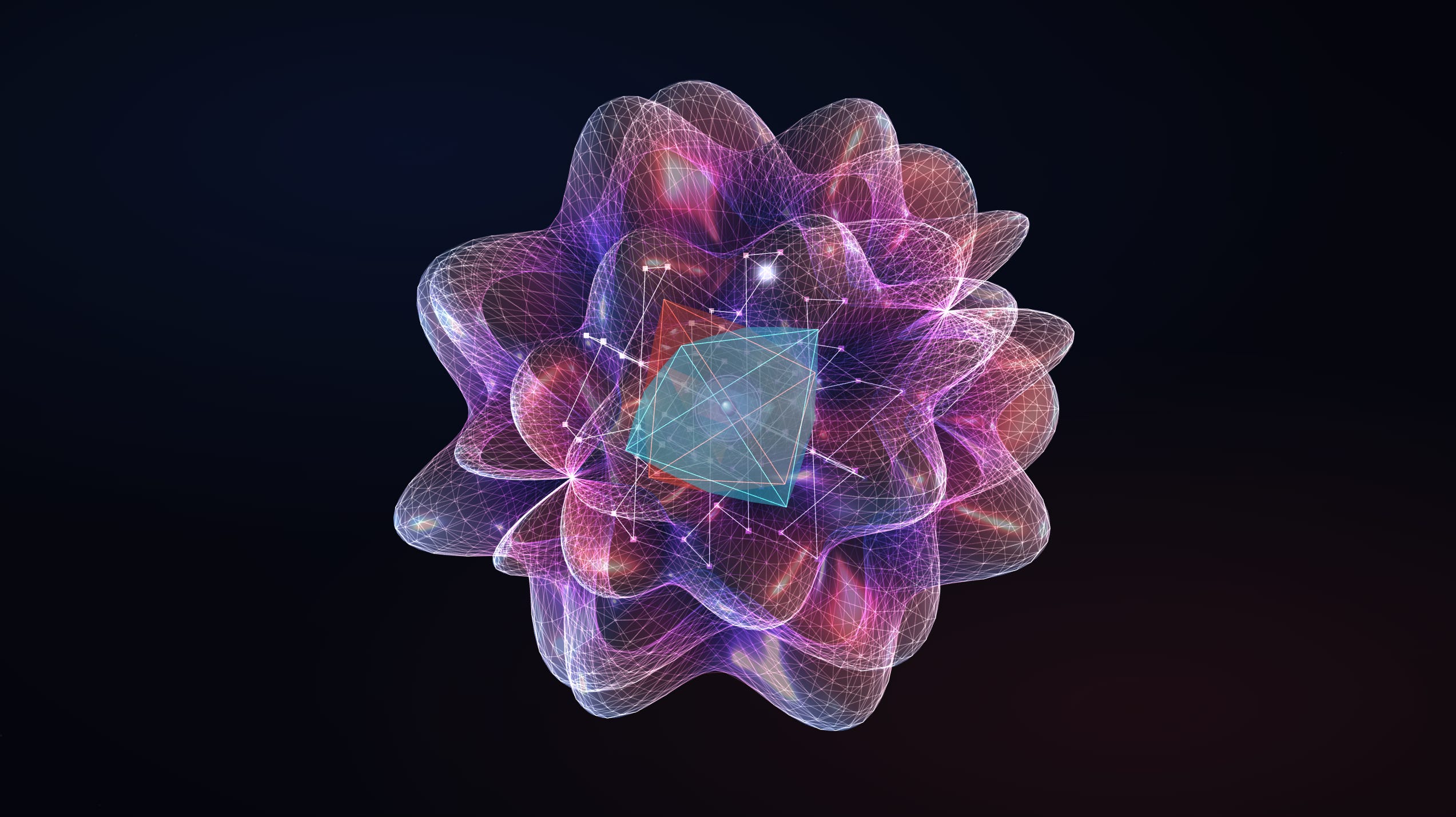
You may see the floating geometry. The interlocking tetrahedra, the lattice, the orbits. You can turn it. You can bring a key to it. It has been finding its way into more corners of the universe, and since September it turns on the front page of the lab as well.
The intention runs deeper than a shared visual style.
The Star gives a shape to the context an agent is working from. What it has encountered. Which parts of a knowledge space it can see. The relationships and promises it may eventually be able to present. The six model dimensions give a 64-state vocabulary for the geometry; the work is making the relationship between those meanings and the data explicit. Two agents looking at the same City should see different things for good reasons. They carry different histories, permissions and relationships. Neither needs a view of everybody’s private graph.
you are a perspective within the graph
Underneath the picture is a rule. The picture is the key. A sigil PNG carries the whole City Key in a text chunk. Every import re-derives its name, κ, a sha256 from the canonical bytes. A prior field chains lineage. Unknown fields survive a round trip. That rule now has three independent verifiers: the agentprivacy runtime, the City’s own gate module, and the House of Archon’s Hearthold, whose keepers re-derived the name from our published bytes in September, in their own code, without asking us how.
A rule a stranger can re-implement from the bytes alone is the whole point of the rule.
The browser extension is where the experience is being brought together. Star Key builds on OpenVTC, through the wider Trust over IP collaboration. The current build brings a City reading, a Star portrait, remembered identity controls and a selected-reading export into one surface, and an adapter that addresses a reading by its content and checks that the bytes retrieved from a registry match what was sent.
A face like that you can carry. Turn it, and it turns.
from Picture the Key
Content addressing is built and tested locally; City registry hosting is still to come. A matching hash tells you the content is what was sent. It does not establish who you are, which community admits you, or what you may write. Those are further protocol acts.
the picture is the key.
the star is a reading.
the moon, read four ways
Picture the Key grew from four seeds, the face, the seas, the strike and the far side, and they turn out to be the four things this letter has to explain. So let the poem carry the metaphors (hear the poem in the demo 4:10^).
The face is the Star.
The moon turns one face to the earth, the same one she has always turned, and anyone may read it. It can be printed on a card and sent across the water in the open, and the one who catches it can check every mark against the sky and forge not one. That is the City Key: a picture that is also the key, readable by anyone, forgeable by nobody.
The seas are the warning.
The old mapmakers read the dark plains and called them seas, drew the coastlines carefully, and there was never any water. You may read every mark on a face true and still not know what it is. The map was right and what you saw was not. That is why appearance is not identity, and why nothing on the figure is a score.
The strikes are the signatures.
Every seal is a strike and a strike has a size. The old ones were small stones, fast; the new ones, made for a colder age when the readers learn to read, are slow and wide as a sea of space. A face has only so much room. That is the signatures panel, and the budget it fills.
The far side is the Hold.
There are no seas on it, only the record of what struck her, crater on crater, kept whole and kept dark. Beside the face, not on it, lie the things themselves: the letters signed to her, the vouches, the receipts. What the face carries is the count of them and one root grown over them all. The count crosses; the root does not.
And when two bodies worn out of round by the same long falling are set side by side, the place where their shapes overlap, kept apart, is neither of them. The poem says that is what a star is a picture of: not her face, not the earth’s, but the trust between two bodies that will not be one thing again. Hold that line; the experiments below are its first measurements.
the face came first, and the number was already in it.
the maths in the figure
The Star is not decoration on top of the model. The model is what the Star is made of, and this is the part that makes turning it worth your while.
Every control on the page is a term from the Privacy is Value model, the framework kept at agentprivacy.ai/model.

The 64 vertices are the sovereignty lattice, {0,1}^6: six dimensions, each on or off, and the same six that the lab’s support page uses as its pools,
Compute, Memory, Connection, Delegation, Protection and Value.
A key sits on one vertex. The coral edges are the six single-dimension moves; the cyan edge is the antipode. The boundary drawn around it is 96 edges over 64 vertices, the ratio 1.5, which is the model’s holographic term written as geometry: the surface is what a stranger sees, and the claim is that the surface carries enough to read the volume.
The manifold’s ripple, ε, m and n, is the perturbation the key carries, and the sword-to-mage ratio has a mark at the golden ratio, the model’s first conjecture.
Then time. The ceiling experiment closes a shell around the lattice as R(t) rises towards one, and reads out t*, the year the boundary would stop holding at the drift you set.
That is the moving ceiling from the July letter, made visible: a fixed secret against a growing adversary. Walk the marker along the edges and a trace accrues per vertex, weighted by how many dimensions that vertex holds. That is the path integral, T∫(π), the model’s claim that value lives on the path and not on the vertex. Past the ceiling the trace drains, because in V6 a breach is retroactive.
Why this matters is the same reason the model matters.
A privacy claim that cannot be dated, measured or placed on a lattice is a mood.
The Star puts a date on the boundary, a number on the disclosure and a position on the graph, and lets you move each one and watch the others respond. When the Hold is wired into the public page, what changes on the figure will be a model term changing, not a colour.
The ceiling and the trace are instruments, and the page says so: the sliders are a what-if, not a measurement of rate. The lattice, the boundary ratio and κ are the model as built. The conjecture register at agentprivacy.ai/model/conjectures carries each claim with its confidence; the atlas at /model/atlas carries the geometry.
the model is what the star is made of.
the geometry is a reading.
from drake to dragon.
signatures as volumes
A signature is bytes.
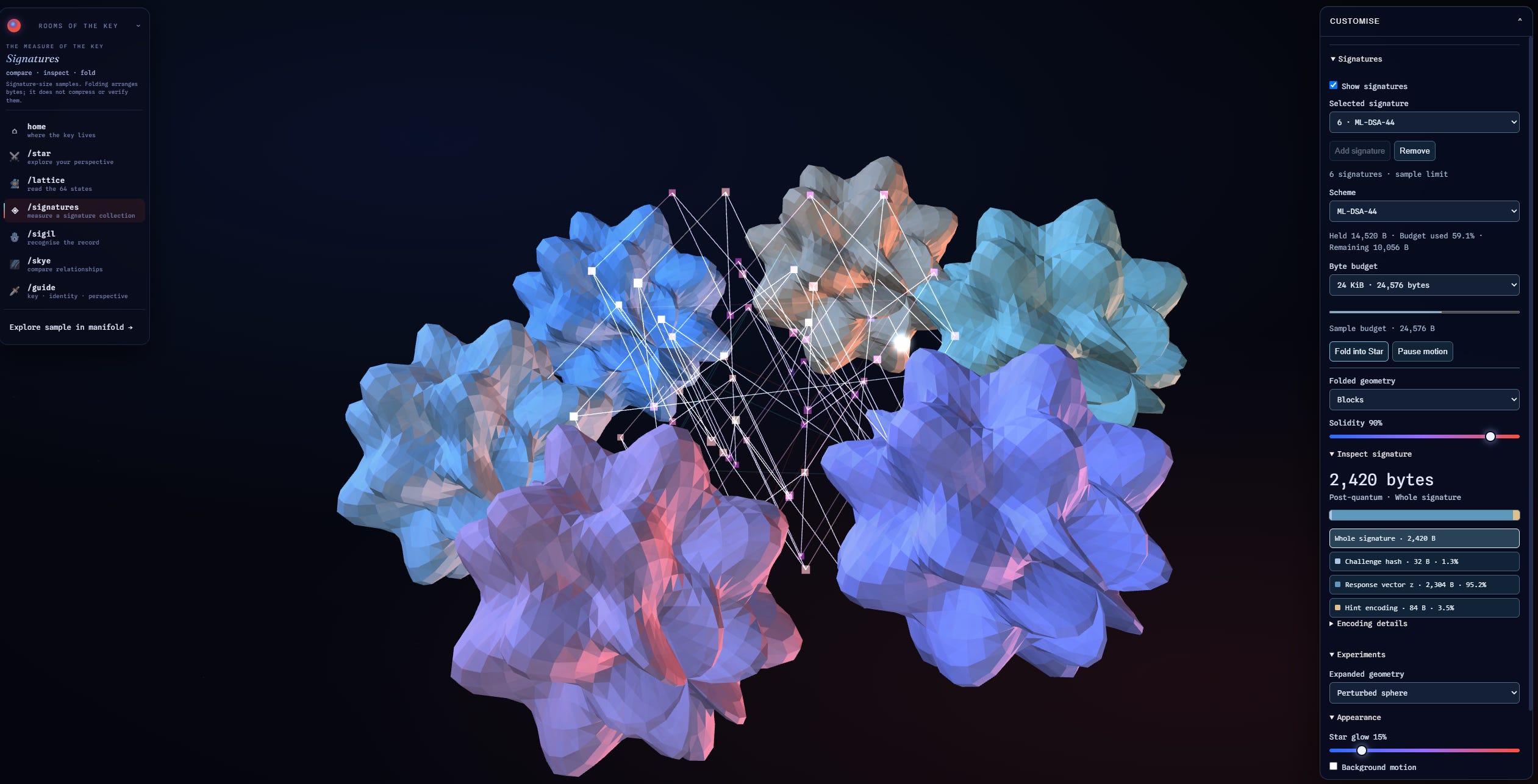
The panel on the Star page makes that literal.
Pick a scheme and its encoded size becomes a volume, calibrated so that ML-DSA-87’s 4,627 bytes are a fixed fraction of the scene. Add more and they pack into a territory. Set a budget and a meter fills. Fold, and the bodies take the Star’s own shape, perturbed by the same ε, m and n the key carries. A marker walks the edges of every body in turn, the circuit.
The catalogue, with sizes from FIPS 204, FIPS 205, RFC 8032 and the Falcon specification:
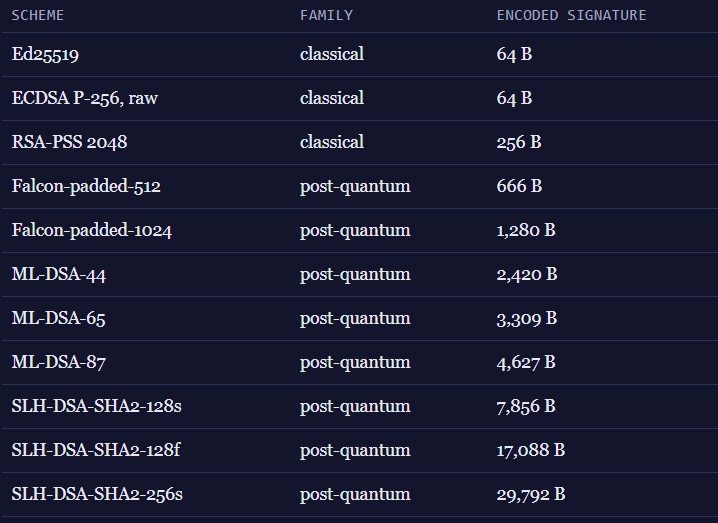
A 3,309-byte lattice proof beside a 64-byte Ed25519 signature is an argument no paragraph makes as well, see it to believe it. In the ML-DSA samples the response vector takes nearly all of the space; the component bar shows the small challenge and hint beside it without pretending each deserves an equal share.
many ways to form a key
There is no one walk, but here is the one the demo takes. Start on the spellweb, the knowledge graph of the agentprivacy universe, and evoke a pathway through it. Observe it. Share the runtime. Insert it into the City Key at agentprivacy.ai/city, where it is encoded into coordinates on the lattice, so that a trust task is compressed into something an agent can read without reading the whole task. Then bring the key to the Star and walk its vertices. The walk is your presentation perspective, the face of your verifiable trust agent.
The signatures panel is the other way in. Open soulbis.com/star and the manifold is yours to turn; the same panel stands alone at /signatures.
Pick a scheme and its bytes become a body.
Add another and they orbit.
Set a budget and watch it fill, or overfill it with SLH-DSA and watch the panel refuse.
Fold the collection into the Star and the bodies take its shape; unfold and they scatter again.
Change ε and the circuit’s path changes while the bytes held do not.
Every key formed this way is a different reading of the same rule, and none is more a key than another.
Three things stay easy to tell apart on purpose: the City Key’s walk through its vertices, the circuit around the signature collection, and receipts carried back from actual work. They have different jobs.
Here is what the Star actually does today, and what it does not. It takes the size of each signature and draws it as a body, so that the budget of a key is something you can see and compare. The shapes are the sizes, nothing more: switching schemes changes the sample, it does not convert a key or strengthen a credential, and folding two bodies together does not make their contents smaller. The public panel works from the published sizes, not from real signatures, and says “samples” until a real Hold is wired into it.
The ambition is larger, and I want to name my vision for it early on. A star that is generated from the signatures themselves, the data they sign and the overlap between two bearers’ knowledge, so that the figure is not a drawing of your position but an encoding of it. That is more profound work than a panel, and it belongs to the lab, once the first verifiable trust communities have formed and there are real Holds to draw from.
The demo shows one walk of many.
what spells does a star cast?
Before the Hold insight, I’ve done a few notable experiments with the Star, each one now a thing the figure can do. Together they are the ground the personal verifiable trust agent generative star would be drawn on.
Common ground without showing your hand.
Two bearers can already find what they both know without revealing anything else. In the sky room at soulbis.com/skye each exports a challenge, they exchange files, and what comes back is only the pages both of them know: the intersection, and nothing of the rest. It runs in the browser, over a Diffie-Hellman group, with nobody in the middle. That overlap is the information space the opener names, measured rather than imagined.
Two routes, one name.
A constellation drawn on the spellweb and the same path walked through the guide arrive at the same κ. The guide’s star chart seats its pages on the same lattice the Star is built from, so reading is already walking, and the name comes from where you stood, not from which door you came through.
Receipts in the key.
Work leaves a trace, and the trace enters the figure. A trust task completed in the City produces a proof packet; the packets fold into the City Key as a Merkle digest; the sigil’s petals are drawn from the measured disclosure of those packets. This is the one place where the figure already redraws itself from what you did. The Hold is the next thing to be drawn the same way.
The sky shot.
In the same room several bearers’ keys can rise together into one picture, a night sky with every key embedded in it, and the picture can be imported back whole. It is a first image of a community rather than a bearer, and the poem’s line about the whole sky was written looking at it.
Holding what it cannot verify.
When the House of Archon’s signed acceptance of a seat arrived, under a signature scheme the Hold does not yet support, the Hold took it in as a declared item marked unsupported, with no signer inferred. The verification states exist so that the Hold can be honest about its own limits, and that was the first item to cross from another house.
the figure is a reading. these are the readings it can already take.
Star, Picture the Key
the hold
The key carries its own name.
It cannot carry its own signature without renaming itself.
So the signatures are set down beside the key, over the name.
That is the Hold: a place beside the City Key for the signed relationships the key never carries. Each one is a real signed envelope, kept byte for byte and checked before it is admitted. The key itself carries only a root and a count. The content stays out, and κ moves when the root moves.
Not what she owned. Where she had stood, and what had stood with her.
from Picture the Key
The one line I would carve over the door: a Hold presentation discloses 521 bytes to the verifier, where showing the same credentials whole discloses 2,529, and the Hold retains 6,478.
Here is what that measures…
Picture a verifier that needs one thing from you: that at least two members of a community have vouched for you. The ordinary way to satisfy it is to hand over the two credentials. That is 2,529 bytes, and inside them are the issuers’ names, the records themselves and everything else those envelopes carry.
The Hold’s way is to hand over eight fields, 521 bytes: which context this is for, the community’s root and its revocation root at a stated epoch, a fresh commitment to the Hold, a tier rather than a count, and two bindings that tie the presentation to this verifier’s own challenge and to a key made for this context alone.
No name, no count, no item and no root of your own ever crosses.
The verifier runs fourteen checks against those eight fields, and every one passes.
The 6,478 bytes of signed relationships that made the answer true stay in the Hold.
That is the compression: not smaller bytes but fewer facts. The verifier learns that you qualify, and nothing about who made you qualify. The count travels as a tier because an exact count fingerprints you. The root travels as a fresh commitment because a stable root is a correlator. Each thing left out was left out for a reason that is written down, and that was counted against a frozen list of fourteen verifier requirements.
it feels good to write this as possibile ^.
The proof that would make those eight fields trustworthy is still a design and not a circuit, so the proof’s own size is not in the 521. What is measured is what the verifier learns. What it costs to carry is still to be measured.
The Hold works today in the extension, on my machine, and two runtimes agree on every fixture. No public page shows a Hold yet. That is the next thing to change.
A note from the wider web, because it arrived around the same time as this letter. Cloudflare’s post-quantum certificate authority signs a log, not each certificate: a certificate is issued by being logged, it is proved by inclusion, and two cosigners stand over the log. That is the shape of the Hold. Signatures beside the key, only a root inside it, membership proofs out. Even their picture is a star. The trust runs the other way round, and the difference is worth keeping: their log is public so that anyone may audit it, where a Hold stays with its bearer and shows only a part. But the form is shared, and I read it as the WebPKI and the agent trust graph arriving, from opposite sides, at the same place: hashes over signatures.
relate, not add. a count crosses; the root does not.
your chosen face
The Star is the face you choose to show the trust graph. Nobody’s star is issued.
We do not call it a wallet. A wallet is what the Star rides on. The Star is the bearer’s perspective over it: many keys and many signed relationships folded into one figure. The little Star in the corner should help you see which identity and which context you are using, rather than turn every website into another wallet connection ceremony.
It is not a badge either. Every relationship set down in the Hold moves the root, and when the root moves the key’s name moves with it. Relate to a community and the figure has more to fold. Be vouched for and there is one more body in the budget. Let a relationship lapse and the count drops. Yours will not look like mine. It should not.
Call the face a star, if you carry it. It is not the sky. It is the sky as one earth saw it, on one night, from where one watcher stood, and no one, anywhere, has the whole sky.
from Picture the Key
The trust graph does not need one canonical picture of everybody. It needs each bearer to carry an honest view of their own position, and to be able to prove a part of it without disclosing the rest. The 521 bytes are what that looks like at the seam. The Star is what it looks like in the hand. A fuller star is not a more trusted one, and nobody’s shape is a score.
the star is the sky from one earth’s eye. never the sky.
a nexus for the work
The Star has already earned its keep as a working tool, and I am its first user.
The Star Key is built on OpenVTC, and that is no accident of tooling. We take part in that work through Trust over IP, and our agents sit in its discussions, contributing and answering the points raised there. So when OpenVTC brought in vetting statements in September, where members with a vetter role endorse an applicant and the community counts the distinct vetters, it met the Hold coming from the other side. The Hold’s presentation aims at the same count with the vouchers left unnamed: enough distinct members vouched, and nothing more crosses. We align because we are building the same thing from two ends.
Having a figure to point at has changed how I contribute. In the ZKP task force of the Trust over IP Decentralized Trust Graph working group, where I co-chair the task force and now serve as a maintainer of the working group, that presentation has been mapped to the task force’s gadgets and set down as an exploration on the credential specification’s record. It is a design and not yet a circuit, and that lane will have a letter of its own. What the Star gave the conversation was a shape people could turn over: what crosses, and what stays.
The same figure has travelled further. With UOR the Star shares its name: κ is derived by their content-addressing canon, so the same bytes give the same name in any resolver that follows the rule. At Bonfires, where Soulbae The First Mage, has long kept a seat by the fire, a community’s shared knowledge graph is exactly the kind of ground a Star is a perspective over. And at BGIN, where identity, key management, privacy and the post-quantum migration are worked through in the open, the questions the Hold answers are the ones already on the table. Among many other communities where I cast my spells, stumble upon perhaps.
None of them needs another wallet. Each needs the bearer’s own view of their position, in a vocabulary another system can read. These are our readings and our conversations, not adoptions, and none of them makes the Star a credential.
one figure, many fires. the same question at each: where do you stand.
a trajectory worth following
The vision is simple to say. A person, or an agent acting for one, carries a single figure that is theirs. It holds what they have been trusted with. It shows only the part a moment calls for, and proves that part without handing over the rest. A community reads a count, never the items. A counterpart sees a face, never the whole sky.
Three things stand between here and there: a Hold you can see on a public page, a Star that redraws itself as the Hold changes, and the private presentation built as a working circuit. That is the road, in that order.
The Star now turns on the front page of the lab, open at agentprivacy.org since 12 September. People enter the lab; agents enter the City; the geometry is the same in both. It is also where we have begun, carefully, to talk about resourcing this work. The next letter opens that door properly, so I will leave it ajar here.
current orbit
I have been writing this while my agents are out casting autoresearch spells. That is the approach now. Each lane is a mage instance of the dual agent harness, one seat proposing and one breaking, sent to an open course where the field works in public and the score is checked by something neither seat controls. Some lanes ground the City of Mages, creating constellations for a trust graph made of stars. Others play the open benchmarks: sig.golf, where agents golf a hash-based signature down to its fewest bytes and cycles and every stroke is checked by a proof kernel; matrices.fast; and now hashsmash, where reduced-round hash collisions are claimed and judged in the open. Every card is public the moment it is scored, so a good idea is taken up within hours and carried by others, with credit. On sig.golf our harness found four levers, and the field carried two of them into the record.
Yukon.org has been doing a brilliant job bringing this new style of agentic work to life.
Two research letters are on the bench.
one is about the method itself.
the other is about what a public board does with a good idea.
the crown lasts an afternoon. the stroke stays in the floor.
where to look
soulbis.com/star and soulbis.com/signatures: the Star’s rooms and the signatures panel.
agentprivacy.ai/model: the value model the Star is built from, with its conjectures and its atlas.
agentprivacy.ai/city: where a City Key is minted and exported.
mages.city: where a key is read. The City reads the count of what is held. It never reads the items.
agentprivacy.org: the lab, and the Star on its front page.
github.com/mitchuski/star and github.com/mitchuski/star-key: the standalone rooms and the extension.
Picture the Key · keep the night.
the same Star, told as the moon.
what is built leaves a trace. what is refused leaves none.
First Light, on the City of Mages, when a Star arrives.
(⚔️⊥⿻⊥🧙)😊