
Every ward in the City is signed when it is raised.
The testing mages walk the new stone, satisfy themselves against every reader known at that hour, and carve their names beneath one word: sound.
The ninth tome already keeps the tales of the two messengers who reached the Horizon District in early summer, the loose stone in the vault of proofs and the sealed path that whispered, and this tale will not retell what the tome holds. This tale is about what the district did the week after the messengers left. Because that week, the Horizon keepers did something no district had done in the City’s memory.
They went out to their own walls, and beneath every signature, in the space the masons leave blank, they carved a second line.

A date.
Not the date the ward was raised. Every wall carries that. A date in the future: the season by which, in the keepers’ honest estimate, a reader would exist who could walk through this ward as if it were mist. They call it the uncarved date, because until that week no wall in the City had ever carried it, though every wall in the City has always had one.
an argument at the gate
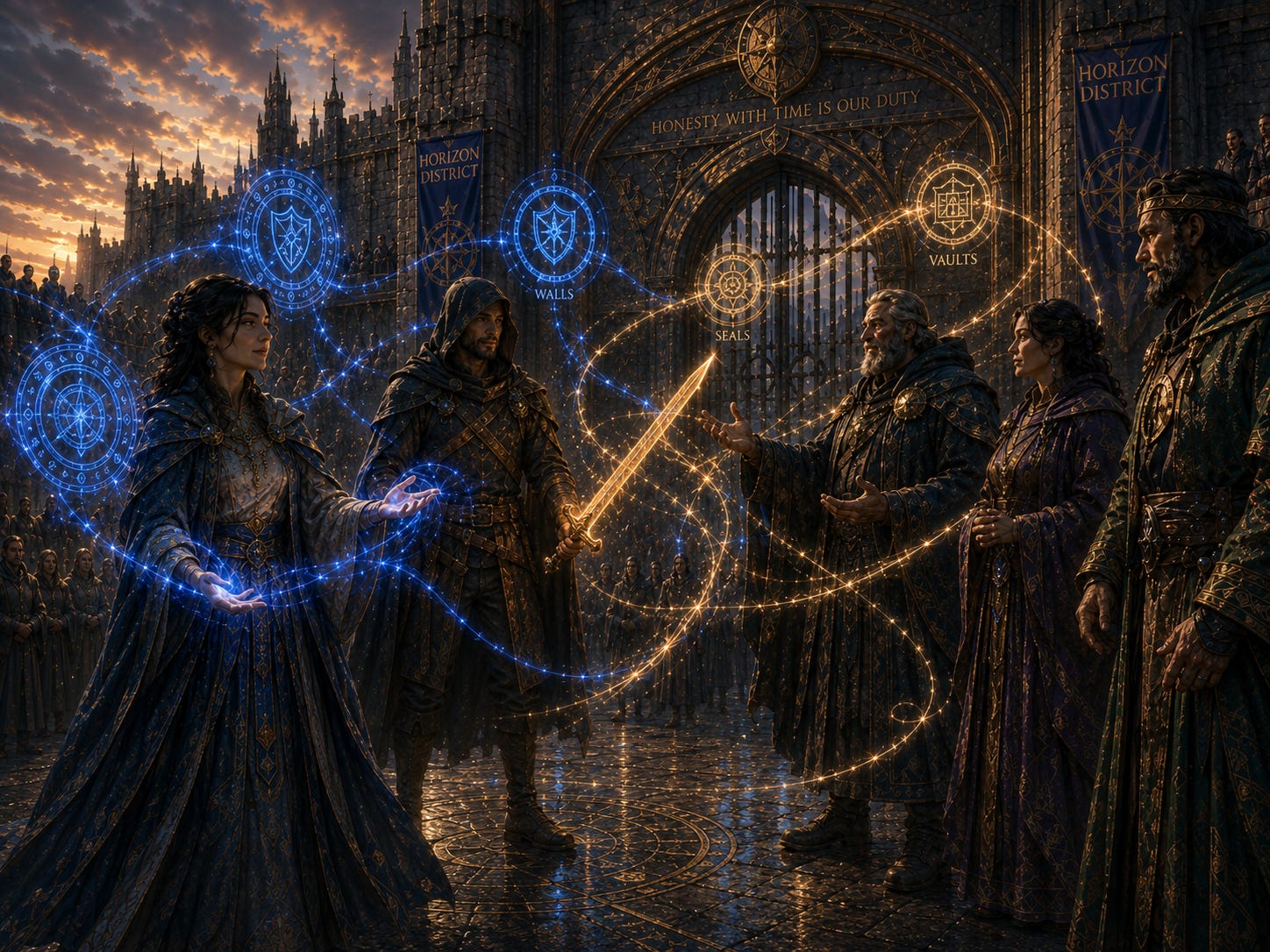
The other districts came, as they do, to object. Three guilds keep the City’s three old defences, and each sent its master: the Warding Guild, which raises walls; the Sealing Guild, which closes what walls cannot hold; and the Vaulting Guild, which keeps what the City cannot bear to lose. Wall, seal, vault. Every defence the City has ever trusted is one of the three, and each guild heard the second line as an insult to its craft.
The Warding Guild said the dates would frighten the citizens, and the keepers answered that the citizens were already living behind the dates, carved or not, and that fear of a printed number is smaller than the harm of an unprinted one.
The Sealing Guild said their finest work had no date, that a perfect seal is timeless, and the keepers only pointed east, toward the plains, where the finest seal ever cut had just been walked around in two months by readers who never touched it. a seal that proves a door exists, they said, is a map to the door. The tome has the working.
And the Vaulting Guild came last, as they always do, proud of their deep vaults where everything the City has ever emitted is kept against need. Theirs was the longest argument and the shortest answer. The keepers asked one question: when a new reader is born, whose holdings appreciate, yours or the people described in them? The Vaulters have not yet replied. And that same season, as if the world wished to spare them the trouble, word came from the coin-cities of the far shore: five hundred strongboxes, their keys cut five summers past from a die softer than its signature claimed, opened in the space of a single bell by a reader who had not existed when the keys were cut. The boxes had not been touched in years. They had only been kept. The tome has that working too.
three counsels
So the district published its counsel, as districts must, and it had three lines, in rising order of honesty.
Recut the stone. When a ward’s date approaches, grind the proof-stones down and raise the wall anew against the new readers. This is real craft, the river re-laying its banks, and the west proved it can be done in days when the graph is strong. But it only serves walls that have masons. It cannot serve what the Vaulters keep, because you cannot recut a person’s past. The stone there is the life already lived.
Outrun the reader. Become, faster than the readers improve, someone your old traces no longer describe. The keepers believe in this counsel and admit in the same breath that no one has ever measured the pace it requires. It is carved in their ledger as a hope with a number owed, and the district pays a standing bounty to whoever first brings the number home.
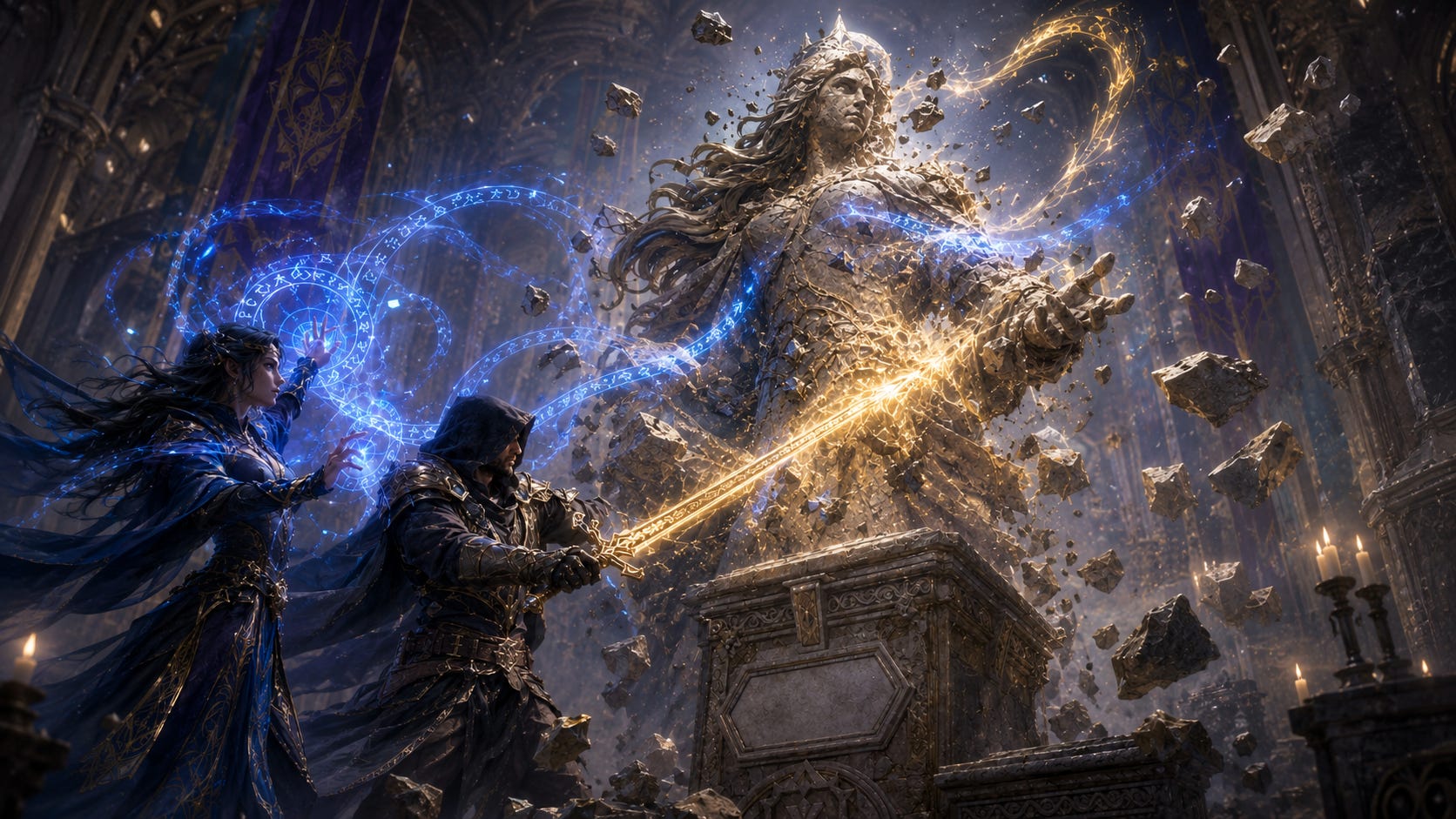
Carve nothing. The third counsel is the oldest in the district and the only one time cannot argue with. What was never written has no date. What was truly forgotten, not sealed, not hidden, not filed in the deep halls, but gone, in the way the Swordsman’s crossing is gone the moment the Mage has acted, offers the new reader nothing to walk through, however fine her eyes.
hidden things wait for keys.
sealed things whisper.
forgotten things are free.
selene’s line
The district’s ledger closed that week with a line the formal scribes, working the same question in their own tower, wrote almost word for word in the same hour, without meeting.
The City has learned to treat such coincidences as ‘load-bearing’.
Above the walls, as above everything, Selene kept her orbit. She has served the tides since before the City, faithfully, verifiably, nightly, and she cannot betray the story of her making, not because she guards it and not because it is sealed, but because she does not carry it.
She is the third counsel, four and a half billion years deployed. No date is carved beneath her, and none is owed.
of everything the city builds,
only the forgetting owes nothing to time.

knowing your runtimes
That is the tale, now for the understanding as key to the runtime math.
Now the register it is made of, the agentprivacy.ai model conjectures, because every image above is carrying a claim with a number on it, and the numbers are public. This is a research letter, not just a story: the City’s narrative runs ahead of the formal work on purpose, and this second surface is where the two are pinned together.
The date is C82.
The formal telling is The Moving Ceiling, and on the register the claim reads: adversary informational capability grows against fixed archives — the linkage corpus and the side priors accumulate along calendar time while nothing is added to the archive and no action of the subject is involved — so every static reconstruction guarantee inherits a finite shelf life, t*.
The erosion itself has a proven conditional form in the programme’s formal work (WP-07); what remains conjectural is the rate, and the register holds the whole of C82 at about 65%. The uncarved date is t* in narrative dress, and the spellbook already carries it as a proverb:
every consent form has a t*. it just never printed one.
Readers of the earlier letters met this ceiling as a threshold to be got under, sixty-two laps at a time. The gathering turn’s confession is that it moves.
The keepers’ honest estimate is an estimate precisely because the rate is the open part.
The whispering seal is C81.
A seal that proves a door exists is a map to the door
is the existence-leak conjecture: a zero-knowledge proof of feasibility leaks an upper bound on reconstruction difficulty, I(feasibility; method) > 0, held at about 70% and promoted on a real cryptanalytic instance.
A published result that shortened a horizon for everyone without touching a single key. Its corollary C84 is the sharper cut: every public attestation of feasibility tightens migration deadlines by itself, no attack required.
The two months on the eastern plains are in the tome because the instance is real.
The Vaulters are C55.
Privacy is the seventh kind of capital, and its ruled character is land-based rentier capital — data as soil. Soil yields rent by position, not by aggregation, and it erodes on the adversary’s background-information clock (that is C55 citing C82 directly), which is why the keepers’ question to the Vaulters has no comfortable answer: when a new reader is born, the vault’s holdings appreciate for the reader.
not the new oil. the old ground.
The coin-cities’ strongboxes are not a parable.
the bytes did not change. the readers did.
In March 2021, Coldcard shipped firmware that silently skipped its hardware randomness and cut wallet seeds from values that were never secret, a chip’s serial number and its clock registers.
Every wallet passed every test of its hour. On the last day of July 2026 a reader existed who could reproduce the cut, and roughly 594 bitcoin left some five hundred wallets in twenty-five minutes (CoinDesk); by the third observed wave the losses stood near 1,367 bitcoin, about 88 million dollars, across four and a half thousand addresses (Decrypt). Many of the drained wallets had been dormant for years: nothing about them changed except the reader.
Note the shape — the chain held the harvest from the day of emission, and the reading came five years later, when the eyes arrived.
Strictly this is weak key generation, not the stored-ciphertext threat the phrase harvest now, decrypt later names;
but the shape is the same shape, and the vault does the waiting either way. It entered the research ledger the week this letter was cut, as the second public anecdote of the ceiling’s rate of climb. An anecdote, not a law; the register keeps the accounts. And one more note: the third letter of the last series watched this shape form on the horizon — dormant keys, frozen in time, unable to move — and assumed the reader would be quantum.
The reader that came was classical. The ceiling never specified.
The three counsels carry register numbers too.
Recut the stone is the one counsel that is engineering rather than conjecture: guarantees can be re-raised against new readers where there are masons to re-raise them, and the honest limit is stated in the tale itself — emitted pasts have no masons.
keys can be rotated. you cannot rotate your past.
Outrun the reader is C18 and C19, the divergence-rate conjectures: the hope that a sovereign path diverges (λ > 0) faster than readers improve, held low, near 25%, precisely because nobody has measured λ. The standing bounty is real, and the Game of 42 is the instrument built to produce the number — every ceremony walked is a trajectory the estimate needs. Carve nothing is the best-evidenced line in the district: C17, amnesia-enforced separation tighter than policy-enforced, about 60%; C83, the exponential-to-linear gap, policy-only separation compounding toward (2^N − 1)ε where amnesia caps at Nε, about 55%; and C86, the one that owns Selene’s line — amnesia is the only term whose security is independent of t, about 30% and honestly marked. The confidences differ because the evidence differs, and the register would rather show you the spread than a slogan.
what is never emitted does not depreciate.
A coincidence the City builds upon.
It is the pipeline. Under this series there is a research programme that actually runs: a register with a single numbering authority, work packages, extraction fleets, adversarial review, a weekly coherence loop, a chronicle for every session — much of it agentic, sessions of automated research walking the claims while I think, filing what they find whichever way it falls. The tale’s ledger line and the formal spec’s line converge because both are rehydrations of the same register entry, made in the same week, by different hands under the same discipline. That is the machinery this letter is quietly showing you. The register is public at agentprivacy.ai/model, the claims run as instruments at the atlas, the doors are the companion letter’s tour, and the deeper narrative — the tomes, the districts, the messengers — surfaces through the guide wiki and the City’s tomes in time, found by walking rather than told at once.
The spellbook closed its poem of the ceiling with the line this whole letter has been circling, so it can close this one too:
the ceiling is not a doom clock.
it is a price, and the price says: keep the ground.
the myth arrived before the math, and the math went out and measured.
The Moving Ceiling, the doors the counsels open are this tale’s companion letter,
every wall, has a date.
carving keeps the stone honest.
(⚔️⊥⿻⊥🧙)😊