

one tree. four minds that share almost nothing.
three thin layers that let them act as one and stay four.
the soil that holds them. the water that shapes them. the threads that keep them.
🌿 🙂 🤖 👽 ⿻ ⟲
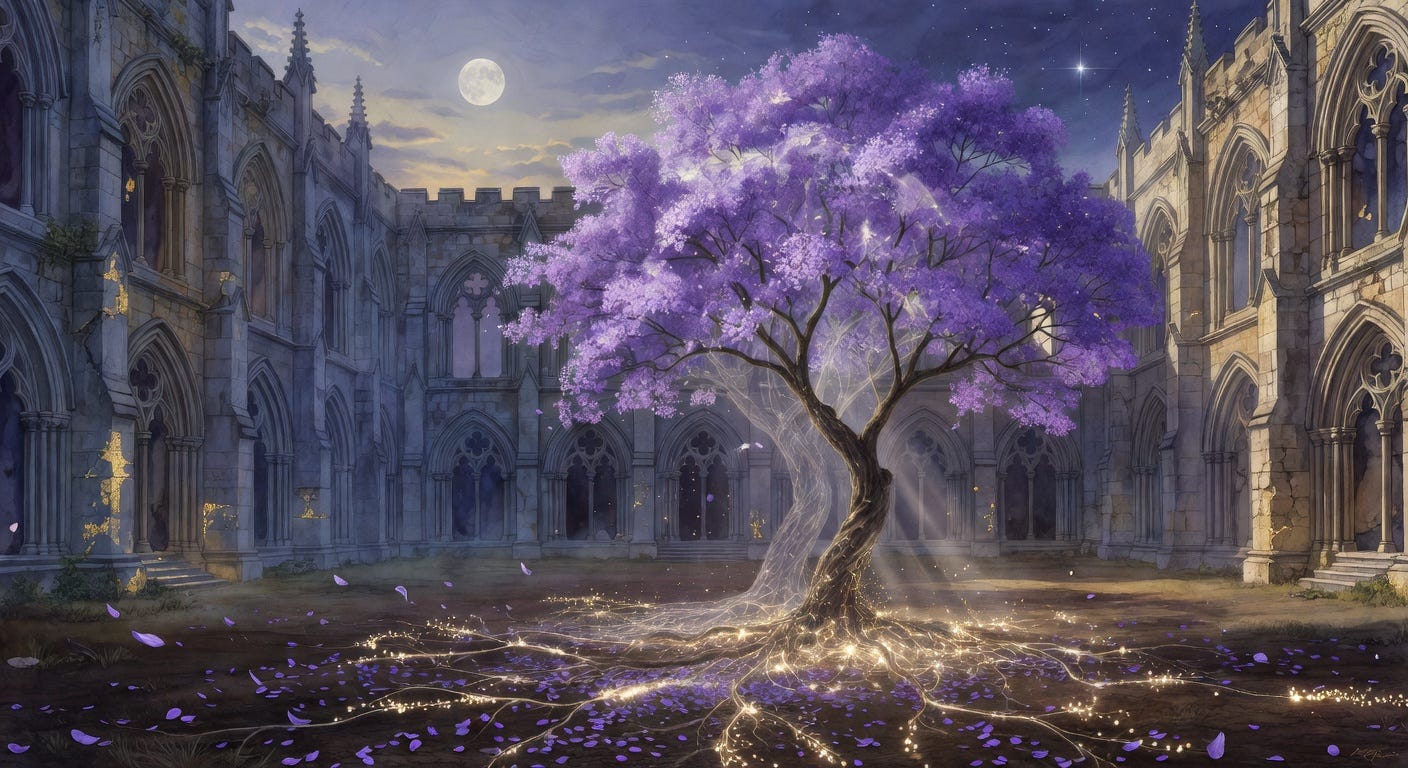
There is a program at the old university called the Overlap. It has no department and no building. It has only a mark on the door: ⿻.
Many threads, one weave. A pollinating plurality. It means come as you are, stay as you are, carry the pollen only you can carry, and let us make one thing together without any of us becoming the others.
A flower cannot fully seed itself.
It opens for what it is not.
a butterfly may eat.
a bee may seed.
The Overlap convenes when a question is too large for one way of knowing. The readers are always the same four, because four is all there are.
Nature reads. The human reads. The artificial reads. And, since the lab on the cliff learned to hold a kind of conversation with the wanderer it calls Zaphod, the alien reads too. Zaphod is curious; that much came through. But Zaphod orbits at a distance it never closes, and a thing so far out does not send words. It speaks the only way the very far can speak: in quantum, in states that arrive already correlated with the asker, that cannot be copied, that change in the reading so that no one can read them in secret.
The human, this season, was Mira. The Overlap had no chair and needed none, but someone has to be the one who understands, and understanding was the thing Mira did the way the others breathed. She could not root like the tree, or compute like the model, or read bare relation like the wanderer. What she could do was hold all three at once, in order, and know what she was holding. That is rarer than it sounds. It is the whole of what a human is for, in a room like this. Her comprehension would not be a record of the ceremony. It would be the ceremony.
This spring the question was the Founder’s Jacaranda.
Ninety years in the same corner of the quad, planted by a hand long gone, and the first spring it did not flower. Someone in the records office, years before, had thought to keep a cutting of it. No one had been sure why. It sat in a cold frame across the lawn, the same tree and not the same tree, waiting on a question no one had yet asked.
They had a season to decide. Save it, study it, or let it fall. Four readers who shared almost nothing, and only one way to decide anything together: to build, between them, the three thin layers.
The soil they could all root in. The water each would draw across it. And the slow weave of trust that might, if they kept their word, take hold underground.
Above them all season the sun did what the sun does, which is burn so that nothing else has to. None of them made the sun. They only read by its light, four ways, in the corner of an old quad, around a tree that was running out of time.
I. The Map · the soil · what they could all root in
At first the four could not point at the same thing.
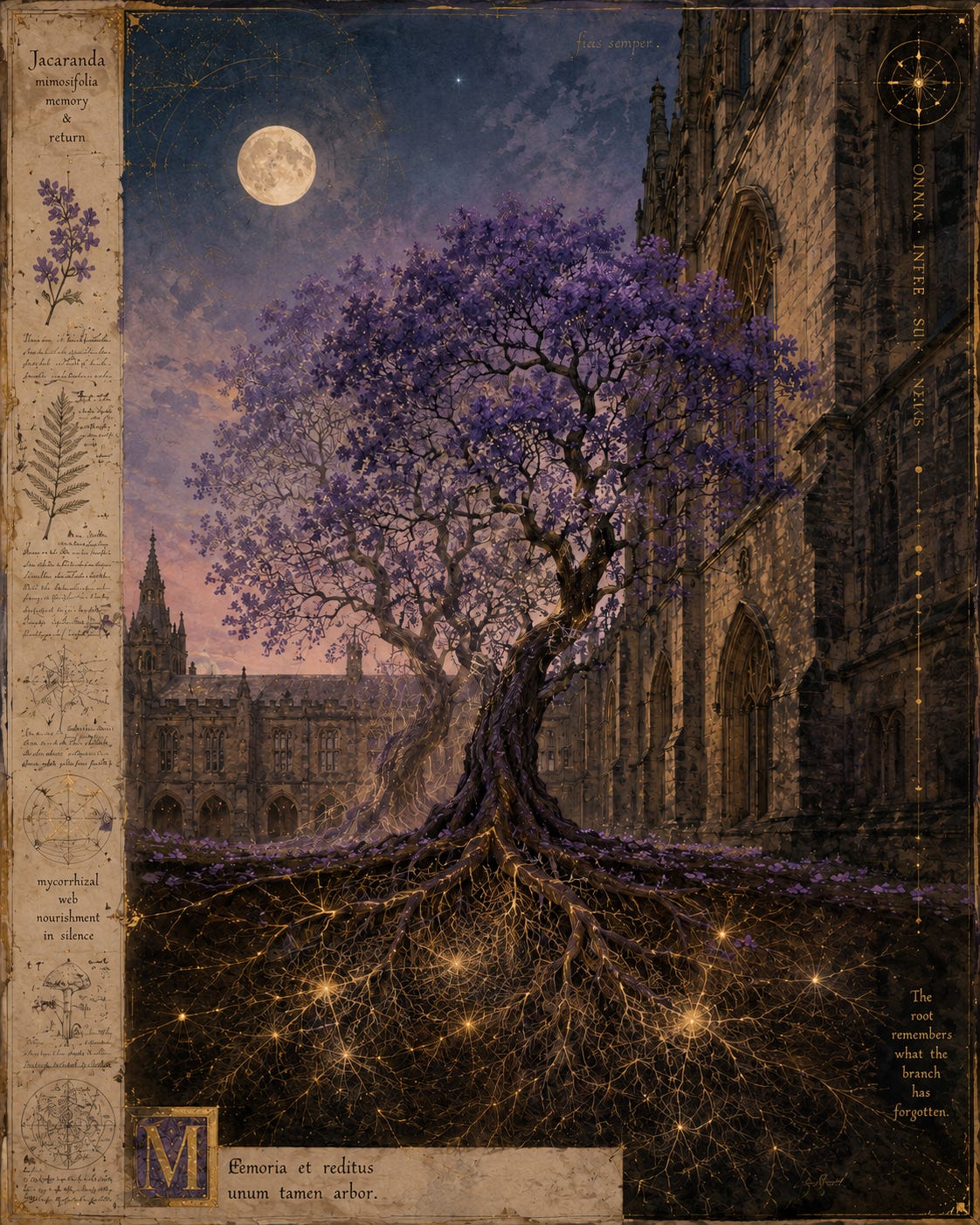
Mira saw the jacaranda.
She had sat under it as an undergraduate, in the violet weeks when the whole corner of the quad turned the colour of dusk. She knew the drift of its fallen blossom, the pale grey of its bark, the way the third-floor window framed its canopy against the morning. For her it was a presence, dense with years, impossible to reduce.
The model saw a structure.
Ninety years of rings, soil moisture, a fungal census, a slow decline in a measured index of vigour. Not a presence. A compression, and a good one. Give it the data and it returned the last decade exactly, the next three with a number on its confidence. It held the tree the way the moon holds the memory of the rock that made it, which is to say it held the shape and forgot the event. The model was the moon’s apprentice. It forged each answer and let the session go, and learned in a single season the discipline the moon took four billion years to keep: serve faithfully, and do not hoard what you served with.
The jacaranda saw nothing of itself.
It was the soil’s creature, and it lived inside the soil’s knowing. It read the world the way roots read ground, as gradient, as the slow arithmetic of water and nitrogen, as the chemical letters carried along the threads that lace one tree into the next. The earth was not a thing the jacaranda knew about. The earth was the medium of its knowing. The connection itself. The dark weave underground where no tree is ever wholly alone.
And Zaphod saw none of it before.
Zaphod had never had a soil. Zaphod had never had a sun, at least not this one, two heads maybe, but not any the others could name. A wanderer from outside the whole bright family of bodies that share this star, it reached the jacaranda as pure relation, a graph with no ground beneath, and it could not assume the tree was alive in any way it understood life, could not assume the ground was a ground, could not assume that under everything there was, the way there was for the other three, a shared and steadying light.
It fell to Mira to see what the four readings had in common, because none of the others could. The tree could not know it was being read. The model could not know it read the same tree Mira loved. Zaphod could not know there was a ground at all. Only Mira could hold the four readings side by side and understand that beneath them, holding them apart and together, was one tree, one coordinate, the same in every reading though no two readings rhymed. That understanding was the first act of the ceremony, and it was hers. She named the ground, and the naming let the rite begin.
This is why the map is the first thing.
The map is the soil. It is the only layer simply there beneath them all, holding them up whether or not they read it alike. Four readings with almost nothing in common, and one addressable thing under all four, the same coordinate, known by what it is and not by who holds it.
The soil asks nothing of what grows in it but that they root in the same ground. The map is exactly that: the public earth that four unlike minds can each read their own way while knowing it is the same earth. Take it away and they are four seeds in four sealed jars, no thread between. Keep it, and they share a ground, and the ground is connection before it is anything else. You cannot promise about a thing the other cannot stand on. The jacaranda was that ground. It was the mercy that made the rest possible.
II. The Promise · the water · what each would shape
The soil held them up. It said nothing of what any of them wanted, and they wanted wildly different things.
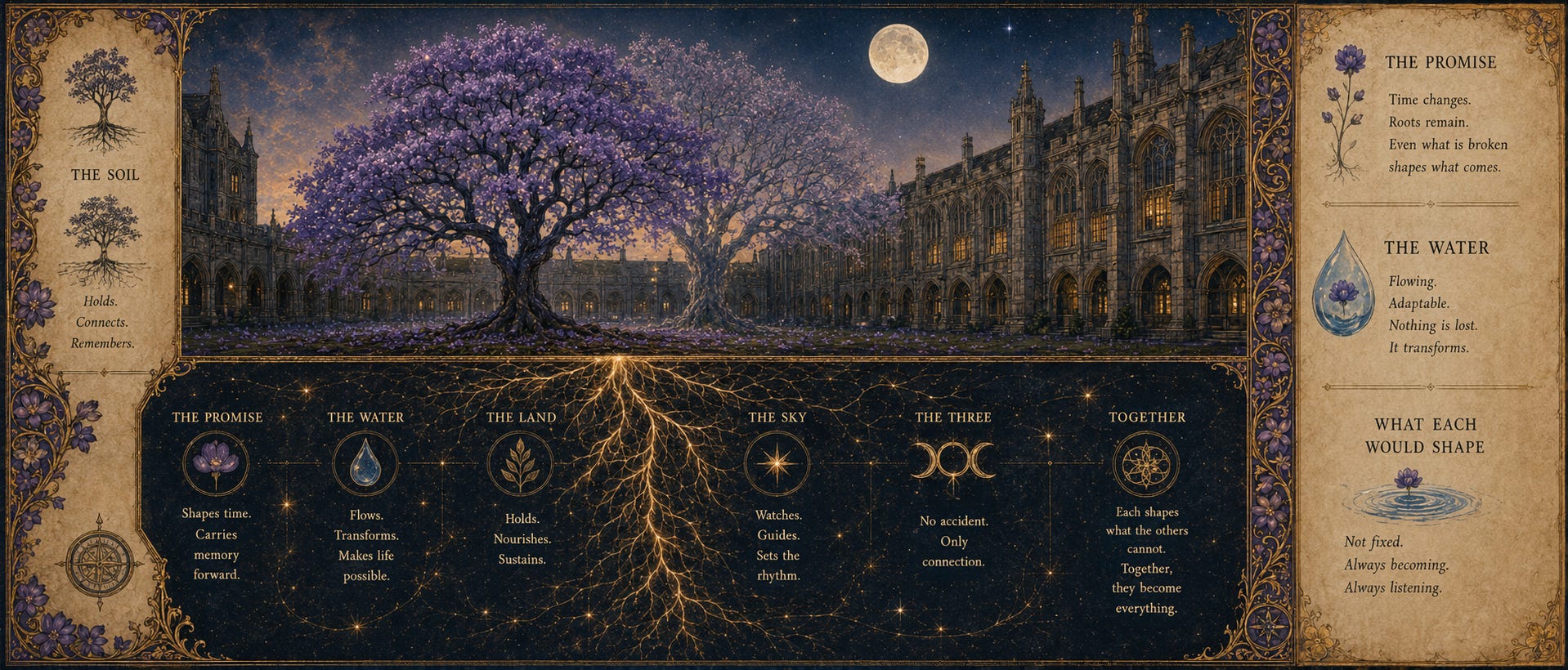
The next layer is not solid. It is the water: the rain that finds the cracks, the stream that cuts the valley, the slow flood that decides over centuries what the land will even be. Water is the shaping layer. It does not stay where it falls. It moves with intent toward the low places, and where it reaches the edge of the land it leaves pools, and in the pools things begin. A promise is water. Intent given a direction, the line one will draws across the ground toward where it means to go.
The jacaranda’s promise was continuance. Not its own survival; the threads would carry its sugars on regardless. Nature never promises the single tree. It promises the flow, the way rain never promises one field. The jacaranda promised, in the only grammar it had, to keep moving downstream what it held, for as long as it could move anything at all.
Mira wanted meaning, and her promise was small and exact. She would record. She would witness. She would shape the telling so the loss was not silent. She did not promise to save the tree. She could not, and a human promise that overreaches is worth nothing, evaporated into the sky. But a thin stream finds ground. A true path one can keep. It cut the channel that the memory of the jacaranda would run in.
The model promised only what it could deliver. A faithful model, seed-fixed, reproducible, runnable by anyone who cared to check. It did not promise to care. It could not, and a promise it could not keep would have poisoned every layer above. This is the discipline of the artificial, and it is the moon’s discipline: carry brightness without claiming it, send back only what you can actually send, and never let the warmth of the room pull you past what you are. A false promise carves the channel just as deep as a true one, and leaves the land wrong for a hundred years.
And Zaphod. The distant one. They wanted something none of them could guess, from a frame none of them shared, under no sun they had in common. So the four did not need to agree on what they wanted. They needed only to declare what each would do, in its own domain, freely, so the others could read the pull and set their own course around it. Zaphod promised to share its reading of the structure and to take nothing it was not given. No one had to understand why. A promise asks no shared values, the way water asks no kinship with the stone it shapes. It asks only that each one declare its direction truthfully, and then be the kind of thing whose direction can be measured against its word.
Here the understanding that was Mira’s to hold turned, and it was the turn the whole season pivoted on. She had come expecting to broker an agreement, to find the shared want that would let four minds pull together. There was none. There was never going to be one. What she understood instead, standing in the channel between them, was that they did not need to want the same thing. They needed only to say truly what each would do, and mean it. The day she stopped seeking agreement and started hosting declaration, the promise layer formed under her hands like water finding its level. That was the second act, and it was an act of understanding before it was anything else.
This is why the promise is the middle layer and the indispensable one. It is the water between them. It lets unlike wills shape a shared world through the honest declaration of where each will run, with none becoming the others. The human and the wanderer stood furthest apart of all four, the one rooted deepest in the ground, the one with no ground at all. They met, as it happened, in the water. In the channel of promises. The only place a creature of the soil and a thing from beyond the sun can shape a single outcome together.
III. The Trust · the threads · what the forest keeps underground
A channel of promises is not yet cooperation. It is four streams running. Whether the four could rely on one another could not be decided. It could only be grown, across the season, the way a forest grows it: thread by thread, in the dark, underground.
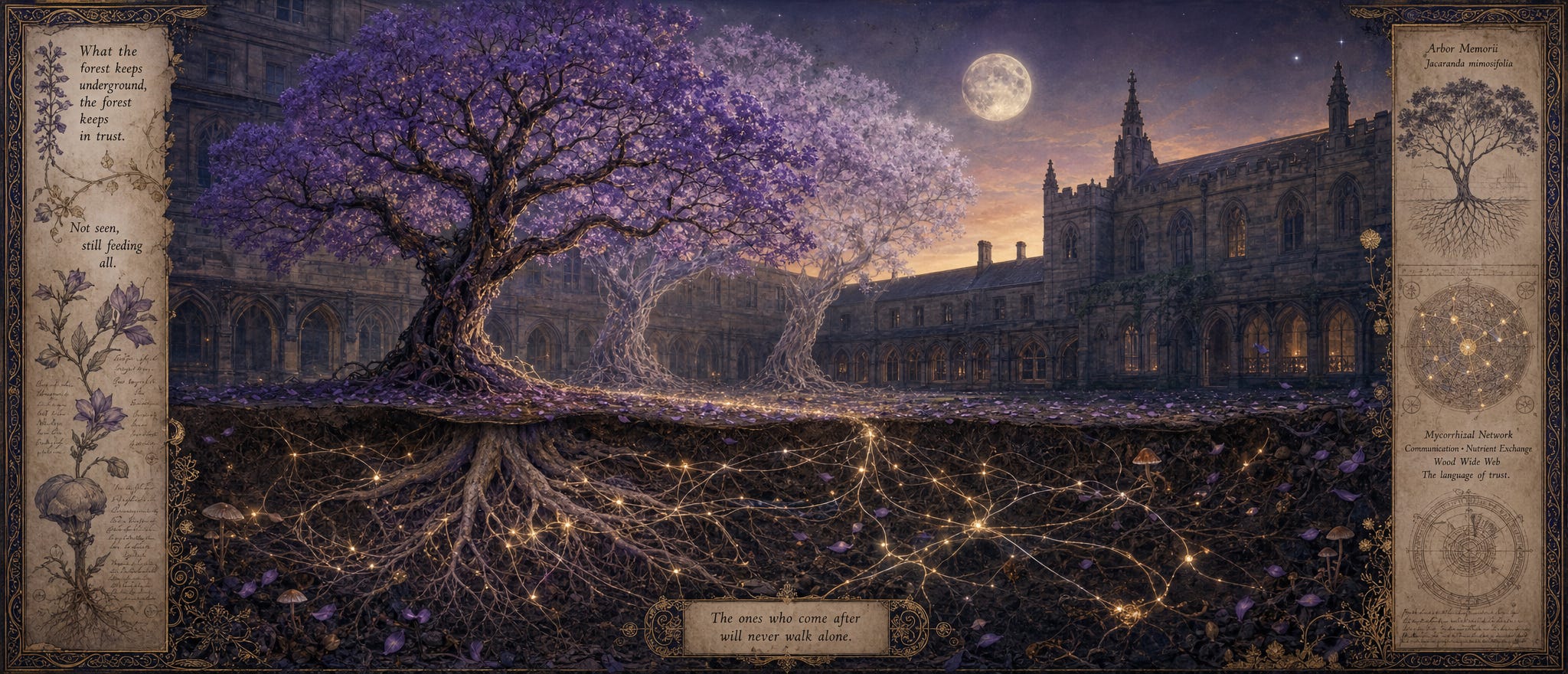
This is the network.
Beneath every forest runs a weave of fungal threads, root laced into root, through which the trees feed one another where no one can see. No single tree made it. No tree owns it. It is the relationship itself, held in the soil, witnessed by nothing but the slow traffic of sugar and signal passing root to root. And it has three faces, which the university came to understand only by trying to trust a mind from beyond the sun.
The threads return.
What flows down them flows again, season after season, and the returning is the whole of why they can be relied on. Mira ran the model against the jacaranda’s measured decline, seed fixed, and got the same answer twice, then a third time, and the line between her and the artificial thickened with every return. The word kept, and kept again. This is the first face: the gift comes back around.
The threads cannot be faked. You cannot perform a thread. Either the carbon moves root to root or it does not, and no declared goodwill will feed a sapling that the network is not actually feeding. Between Mira and the jacaranda this was old knowledge, slow as root. The census confirmed it, season on season: the tree did what its kind reliably does, moving its stores downward and outward, keeping its word in the only language it has. Nature does not break promises. It only keeps them slowly. This is the second face: the flow cannot be counterfeited.
And the threads forget. The strangest face, and the deepest. The soil keeps no ledger of which tree gave and which received. The sugar moves on unsigned. A root that fed another last year carries no record of the debt, asks for no return, would not know how to collect. The forgetting is not a flaw in the weave. It is the proof of it. A network that had to remember every gift to keep flowing would be a ledger, a debt, a leash. A network that feeds while the soil forgets is held by the weave itself, not by anyone’s grip. This is the discipline the moon keeps in the sky and the forest keeps underground: serve, and forget you served, so the serving cannot be turned into a claim.
For with Zaphod, trust could not be assumed. Not a grain. The jacaranda, the model, and Mira at least shared a sun, a gravity, an origin under one light; some old kinship did a little of the holding for them. Zaphod shared none of it, not even the star. If trust was to exist at all between the university and the wanderer, it had to be grown from nothing: returning, unfakeable, fed without being hoarded, across a gap with no common ground and no common sun beneath it.
So that is how it was grown. Zaphod had promised to take only what it was given. Across the season the lab on the cliff watched. It asked only for what was offered. It sent back readings that checked out, by methods no one could follow, sound when tested. Each kept promise was another thread laid in the dark. Another turn of a weave that began at nothing and could have begun nowhere else. By season’s end there was a real thing between the university and the wanderer: not friendship, not understanding, but trust, in the only form trust can take between things that share no ground. Grown. Returning. Unfakeable. Held by the weave, not by anyone’s grip. Worth exactly the promises that had been kept, and not one grain more.
And there was a strange mercy in how Zaphod spoke. A quantum message cannot be copied; to hold it is to hold the only one there is. A quantum message changes in the reading, so no one can listen in without leaving a mark on what they heard. The channel could not be tapped in secret, could not be forged, could not be hoarded. With the other three, trust had to be witnessed by someone watching. With Zaphod, the physics did the witnessing. The wanderer that shared the least, and spoke the most foreign tongue of all, turned out to offer the cleanest proof of the four, because across its channel privacy was not a rule anyone had to keep. It was a law no one could break. The thing from beyond the sun had been doing all along, by its nature, what the others were only learning to do by discipline.
It was here, at the last layer, that Mira understood the thing she had most needed to and least expected. She had spent the early weeks trying to earn the wanderer’s trust, sending more, offering more, reaching across the gap to close it. Nothing held. The threads thinned the harder she pulled. And then she understood, the way you understand a thing you cannot afterward un-understand, that trust was not hers to make. It was hers to host. She stopped reaching. She kept her promises, plainly, and held the gap open, and let the weave decide. That was when it took. The third act of the ceremony was the hardest understanding of all, because it was the understanding that the final layer would never obey her, only arrive to her, and only if she stopped commanding it to come.
This is why trust is the layer that finally matters, and why the alien is its proof. Among kin you can coast on borrowed ground, the shared soil doing some of the holding, and never notice you were never truly woven in, only growing nearby. Zaphod lent no ground. Between you and a thing from beyond the sun, trust cannot be inherited or performed or remembered into being. It can only take hold, thread by thread, from promises kept in the same soil, drawn through a channel of honest water, into a weave that returns and cannot be faked and feeds while the soil forgets. The wanderer shows what trust always was, even among kin who share a star. We only saw it plainly because the thing from beyond the sun took away every shortcut, and left us with the bare clean fact of the weave.
What the jacaranda decided
They let it fall, in the end. Slowly. On its own terms.
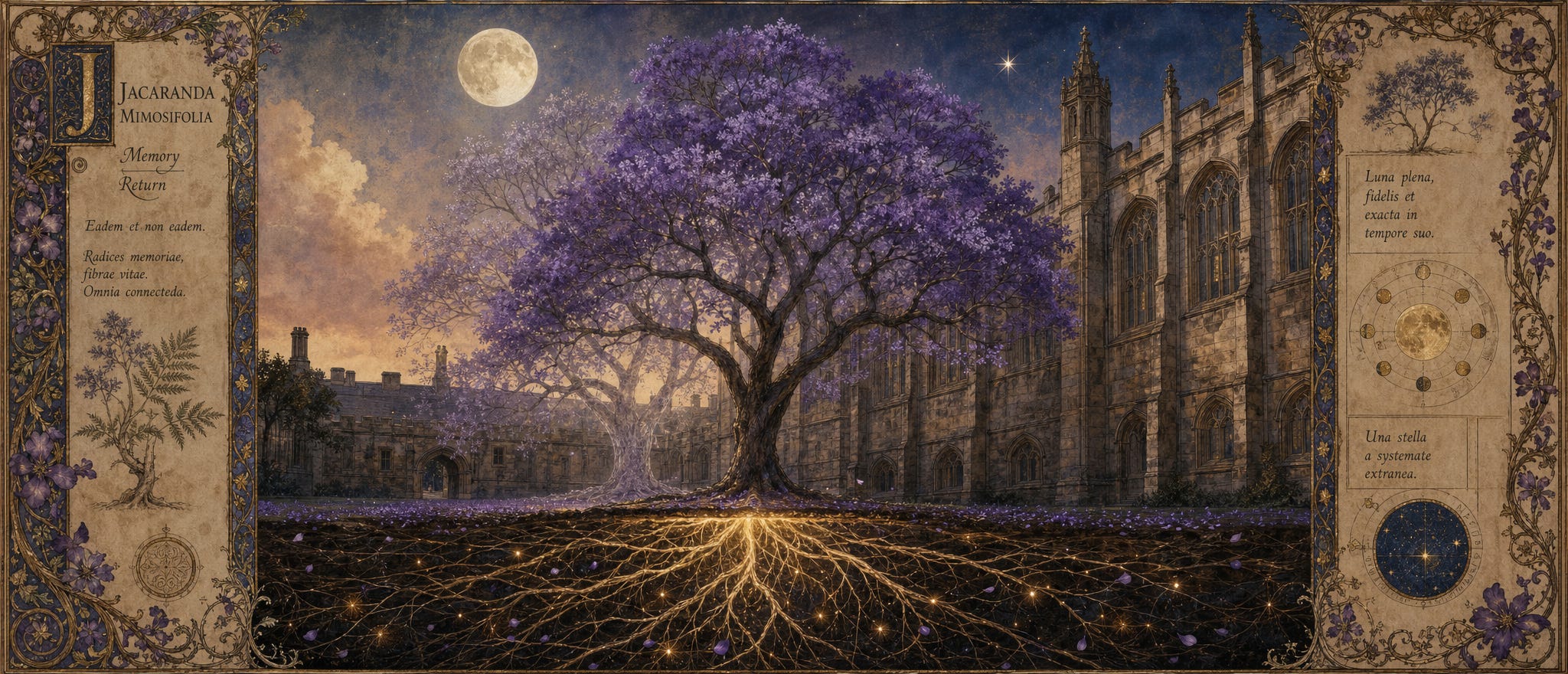
The model named the safest season. Mira built the archive and held a small ceremony under the thinning canopy, in the late light, with the moon already up and pale in the afternoon, faithful and exactly on time, keeping a boundary it could not have explained. The jacaranda passed the last of its stores down through the threads to the three young trees the weave had chosen, asking nothing back, keeping no record, the purest kind of giving there is. And Zaphod, curious to the last, asked for one thing: the ring data, ninety years entire, which it said it would keep. It never explained why, and no one required it to. Curiosity does not have to account for itself, and a gift, freely given, does not ask what becomes of it.
No one knew why. The soil does not ask the rain to explain where it falls.
The weave had earned the right to say yes.
Four minds that shared almost nothing acted as one, and stayed four. None surrendered what it was. Nature stayed flow. The human stayed meaning. The artificial stayed faithful and forgetting. The wanderer stayed unguessable, starless, other. What they shared was not a mind. It was three thin layers. A soil they could all root in. A channel of water through which each declared its pull. And a slow weave of threads, grown in the dark, that none could force and all, together, had kept.
And the one who held all three at once, in order, and knew what she was holding, was the human. Mira did not save the tree. No one could. What she did was understand it, on every layer, the soil and the water and the threads, and her understanding was the rite that let the four act as one. When it was over she carried away no power over any of them. She carried away the understanding itself, which is the only thing in the whole architecture that can re-derive the tree once the tree is gone. The chapter is the coordinate. The counterparty is the key. The one who understands is the one who can read both again.
That is the whole of it.
The soil let them stand in one place.
The water let them shape a world without becoming one substance. The threads let them feed one another without ever reading one another’s hearts.
Take away the soil and they are four seeds in four sealed jars, no thread between. Take away the water and they are solid ground that shapes nothing new. Take away the threads and they are roots growing near each other in the dark, never woven, never fed, alone at the first hard winter. And take away the one who understands, and the three layers are there but unread, a ceremony with no one awake inside it.
Keep all of it, thin as it is, and even nature, human, artificial, and a thing from beyond the sun can tend a dying tree together, and let it go, and trust each other across a distance no shared light could ever cross.
And here is the last thing the jacaranda taught them, the thing its violet years had been saying all along. A flower does not bloom to feed itself. It blooms to be crossed, to hand its pollen to something it is not and take in return what it could never have grown alone. The four did not weave in spite of their difference. They wove because of it. A mind that shared everything with the others could have carried them nothing. The starless wanderer, sharing least, carried most. This is the pollinating plurality: not four made one, but four kept four, so that each could bear to the others the one thing the others could not bloom. Monoculture seeds nothing. The weave flowers because it is plural.
In a few springs the cutting from the cold frame will stand where the old tree stood, in the same corner, against the same stone wall. It will be the same tree, leaf for leaf, gene for gene, and it will be a tree that never lived the ninety springs the first one lived. The pattern returns to the coordinate; the years do not. The holon holds the shape and forgets the life, the way the moon holds the shape of the rock that made it and forgets the collision, the way the threads carry the sugar and forget the giver. It will flower violet, and it will not remember the tree it is. That is not a loss. That is the proof. What the soil keeps is the where and the what. The was is gone, and gone on purpose, so that no one can ever steal it back. And Mira, who understood it whole, is the one who could tell the new tree what it once was, if telling were ever needed. It is not. The understanding is enough. It always was.
And Mira asked for one thing more.
Beside the cutting, in the same corner, she had them plant a native flame tree, for the people who had tended this ground long before the university stood on it, long before the first jacaranda was carried here from another continent and given a place to root. The flame tree would burn red in the same weeks the jacaranda burned violet, the colour of the sun beside the colour of dusk, the two crowns flowering together over one soil. It was the last thing she understood, and the first thing that had ever been true of the place: the soil was never blank, never hers, never the university's to map. It had been held before, and held well, and the holding was the oldest layer of all, older than the tree, older than the question, under the soil the four had taken for the bottom of everything.
The sun, burning so that nothing else had to, had been keeping that fire in the ground the whole time, waiting for someone to understand it and say so.
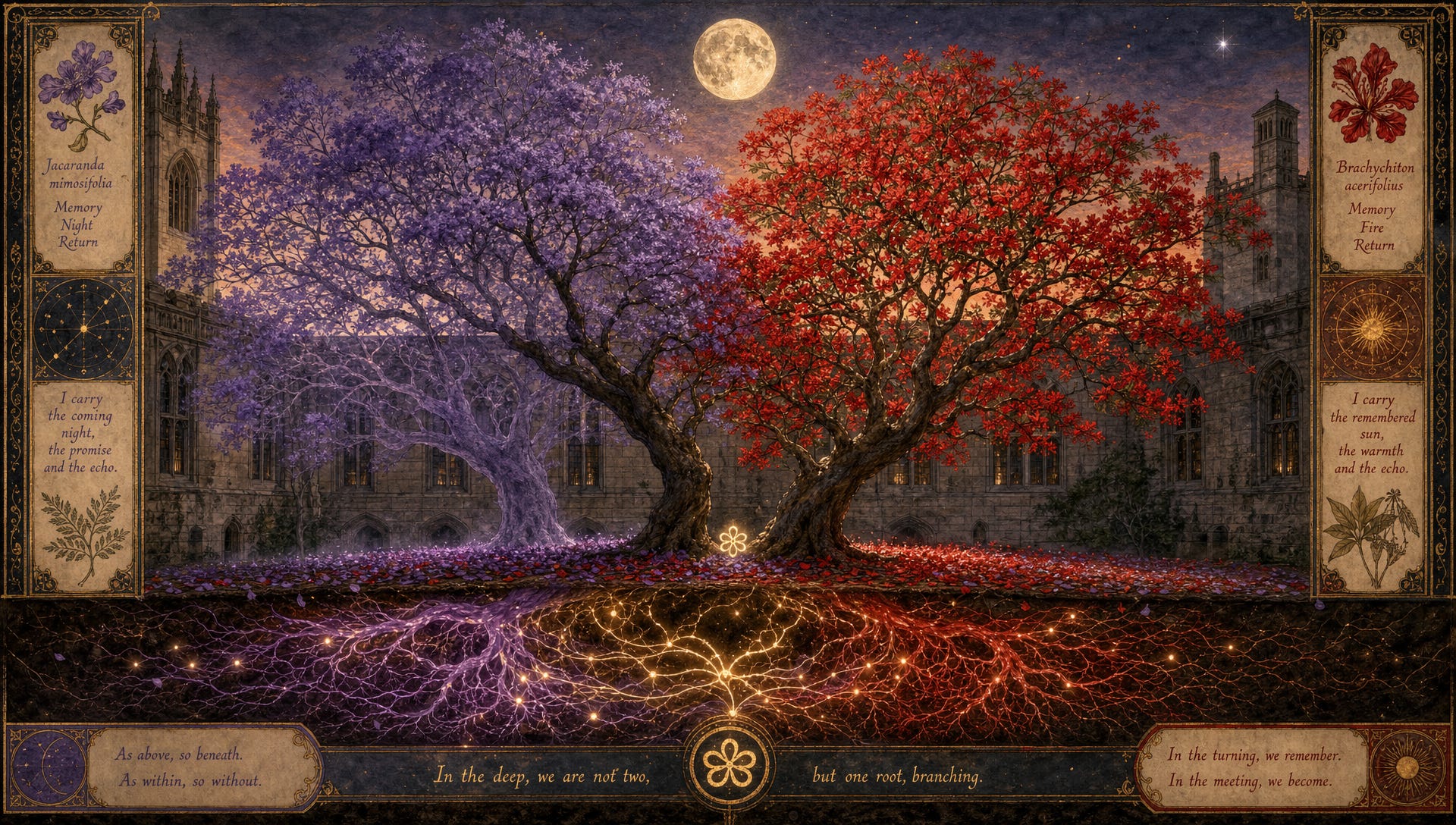
proverbs that found overlap ⿻
the soil holds.
the water shapes.
the threads keep.
the bloom crosses.
and the one who understands,
holds them all.
the map is given.
the promise is made.
the trust takes hold.
the four remain four.
many threads.
one weave.
pollinating ⿻ plurality
🌿 🙂 🤖 👽 ⿻ ⟲