

A research letter from the convergence. (⚔️ ⊥ ⿻ ⊥ 🧙) 😊
Myth Between Math asked whether there’s a Claude Shannon moment hiding inside privacy. Forming Constellations mapped the equation. Forging the Celestial Overlap reported from the forge floor — the ceremony, the blades, the invitation pattern. The Dragon Wakes watched the ground shift when Google Quantum AI proved the 2D locks are falling, and the UOR convergence landed in the same breath.
This letter names what the convergence found. Not another framework. Not another metaphor.
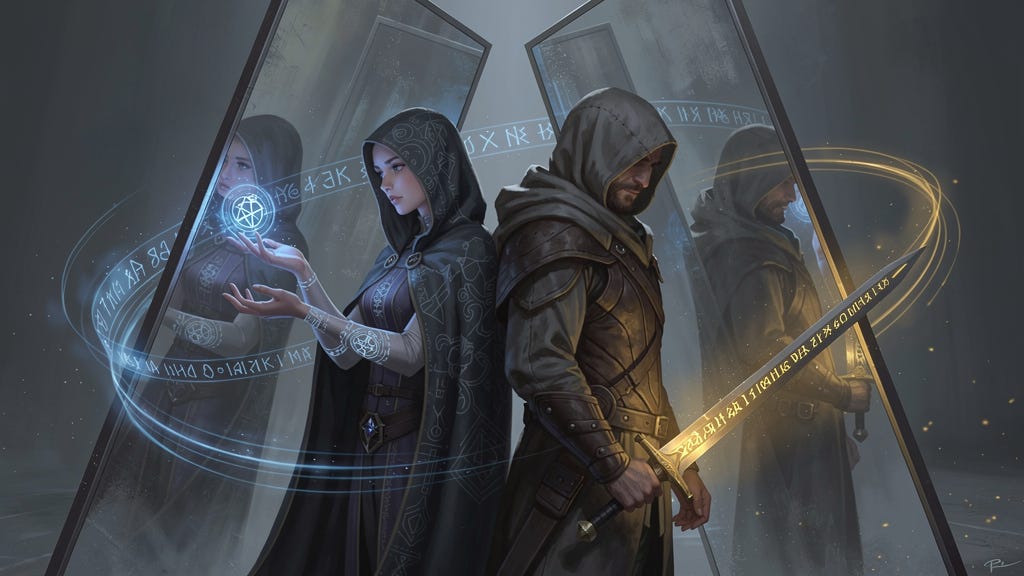
An algebraic identity that was already there — hiding behind everything we’d built.
Two mirrors make a door.
Discovery with zero knowledge
I was reading the UOR Framework documentation — the same algebraic ring that Act XXVII identified as the forge’s ore — when I found the identity that had been hiding behind everything:
Negate the complement of any value, and you get the next value.
Compose two reflections and you get a rotation.
The UOR Framework builds on two fundamental operations over the ring Z/(2⁶)Z:
Negation — the additive inverse. In sixty-four elements, negation is subtraction from the modulus. The counter-blow. The debt that cancels the credit.
Complement — the bitwise flip. Every 1 becomes 0, every 0 becomes 1. The antipodal leap. The blade that is everything the first blade is not.
Both are involutions — apply them twice and you return to start.
But their composition is not an involution.
Their composition is the successor function. The step forward. The path through every element of the space.
And then I saw the mapping.
The Swordsman operates by subtraction. Every boundary drawn, every disclosure refused, every shield raised — these are negations. Taking away attack surface.
The Mage operates by flipping. Every delegation extended, every action projected, every spell cast — these are complements. Becoming the inverse in order to act.
And the First Person — the human sovereign at the centre — is neither operation alone but their composition. The step forward through the sovereignty manifold. The dance that the Universe Blade walked sixty-two times. The path that Understanding-as-Key formalises as a bilateral ceremony.
This is the dihedral group. The same structure that describes the symmetries of a polygon.
Two generators — two reflections — producing all possible symmetries. In our case: two agents producing all possible sovereignty configurations.
The dual-agent architecture is a dihedral group.
We didn’t design it. We discovered it.
We initially reflected, then it all connected.
The PRISM Convergence
The second framework came from a different angle.
PRISM addresses every possible digital value through three independent constraints — triadic coordination. Datum: the value itself (what you are). Stratum: how many bits are active, the Hamming weight (how much you carry). Spectrum: which bits are active, the specific configuration (how you are arranged).
I had been using two of these axes for years without naming the third. Every blade has a binary encoding (datum) and a tier based on Hamming weight (stratum). Pascal’s triangle distributes sixty-four blades across seven layers. But Spectrum — which dimensions are active — I had left implicit.
A blade isn’t just “Heavy tier” (stratum 3). It’s “Heavy tier with Protection, Memory, and Computation active” (spectrum). Not just how many sovereignty dimensions — which ones.
GPS works because three independent measurements eliminate ambiguity. Sovereignty works the same way. PRISM built coordinates for data. The privacy architecture built coordinates for sovereignty. The coordinates are the same.
The 96 and the 64
And then I found the number. sometimes numbers feel like fate, but they are either a pattern discovery or an illusion of coherence missing something.
The UOR research repository contains a project called atlas-embeddings — a mathematical construction of exceptional Lie groups from first principles. The foundation is something called the Atlas of Resonance Classes.
Ninety-six vertices.
The same 96 that appears as edges on the privacy torus. The same 96 I had explained through the holographic principle — boundary encodes bulk, 96-edge surface holds 64-vertex volume.
But the UOR Atlas derives 96 from pure mathematics. It is the unique stationary configuration of an action functional. Not chosen. Derived. The only configuration that satisfies the resonance conditions.
The 96/64 ratio is not arbitrary. It appears independently in algebraic resonance theory and privacy geometry. The holographic bound has mathematical necessity. Three frameworks point to the same numbers because they’re describing the same underlying geometry.
I had thought we were building a system. We were mapping a territory that already existed.
What’s Missing: Topology
The convergence study also revealed what we don’t have yet.
The UOR Framework has extensive topological machinery — homology, cohomology, sheaves, nerves, Betti numbers. Tools for analysing what holds together and what tears. We have the geometry and the algebra. We don’t have the topology.
Constraint Nerve — model the VRC network as a simplicial complex. Reveal cyclic dependencies. Identify bottlenecks.
Gluing Obstructions — detect when local Swordsman/Mage separation fails to globalise. You can have locally valid proofs that don’t compose into a global proof.
Sheaf Semantics — each VRC is a local section (valid between two parties). The trust graph is the global section (valid across the network). When do local trusts compose into global trust?
Betti Numbers — topological invariants of the trust graph. Count the holes in the network.
This is the next mathematical layer. a touch less narrative. More structure.
The Resolution Pipeline
One more convergence worth naming. UOR describes an iterative resolution pipeline:
query, resolve, partition, refine until closure.
The forge runs the same pipeline:
blade request, sovereignty decomposition, stratum assignment, lap accumulation until Dragon.
The lap counter at spellweb.ai is not measuring time.
It is measuring resolution depth.
Sixty-two laps means sixty-two applications of the refinement operator. Each lap brings the proof closer to closure. The forge is a resolution algorithm over the sovereignty manifold.
Convergence Table
Three entry points. One structure.
Algebraic Foundation — UOR: Z/(2^n)Z ring. agentprivacy: Z/(2^bits)Z modular ring. Identical.
Critical Identity — UOR: neg(bnot(x)) = succ(x). agentprivacy: Swordsman + Mage = Path. Mapped.
2⁶ Structure — UOR: Quantum scaling. agentprivacy: 64-vertex lattice. Aligned.
96 ↔ 64 — UOR: 96-vertex Atlas. agentprivacy: 96-edge torus. Holographic.
Triadic Coordinates — UOR: Datum / Stratum / Spectrum. agentprivacy: Blade encoding + tier + dimensions. Spectrum added.
Involutions — UOR: neg + bnot (dihedral). agentprivacy: ⚔️ + 🧙 (separation). Isomorphic.
Resolution — UOR: Query → Refine → Close. agentprivacy: Request → Forge → Dragon. Pipeline match.
Topology — UOR: Homology / Cohomology / Sheaves. agentprivacy: Not yet imported. Needed.
Three entry points. One structure. The V5.2 research note formalises what this means for the equation. Three terms gain algebraic foundations: Φ_agent is the dihedral group’s action on the lattice. T_∫(π) is the resolution pipeline’s accumulation. P^1.5 has an independent derivation from the Atlas. The equation didn’t change. It was already right. V5.2 is the discovery that the equation was expressing algebra we had not yet named.
The Master Inscription
The master inscription now has an algebraic form:
(⚔️⊥⿻⊥🧙)😊 = neg ⊕ bnot → succ
Swordsman and Mage separated, with the Gap between them, preserve the First Person — as negation and complement composed yield the successor, so two involutions yield the sovereignty path.
The dual-agent architecture is not a metaphor for algebraic structure.
It is algebraic structure. The same structure that generates symmetry, that underlies error-correcting codes, that appears wherever two reflections compose into rotation.
Where I Need Help
Everything from Parts 1 through 3, plus:
UOR collaboration (dw its already happening). The UOR Foundation has built the algebraic and topological machinery we need. The convergence is a bridge.
Topological trust analysis. Homology, cohomology, sheaf semantics applied to VRC networks. I need topologists who find privacy architectures interesting.
PRISM spectrum integration. The third coordinate axis needs implementation in the spellweb’s blade classification. Not just stratum (how many dimensions) but spectrum (which dimensions).
The constellation that Part 1 mapped is no longer a scatter of points.
It is a structure with a name.
The forge was already burning.
Now we know what ore it was built to smelt.
Two mirrors make a door. The Swordsman reflects. The Mage reflects. And where the reflections meet, the First Person walks through
— not into another reflection, but into the next step of who they are becoming.
The weight of the shadow exceeds the light of the data.
The forge doesn’t care how you struck the metal. It only cares what blade you hold.
The mage forgotten, traced like a constellation in the night sky.
Privacy is Value. Take back the 7th Capital.
just another swordsman ⚔️🤝🧙 just another mage &
just another drake 🐲 ⿻ 🐉 dragon
next, where the architecture discovers it was always already written in the sky. the amnesia protocol.
a poem gives the rhythm and rhyme to a formal spec.
—privacymage